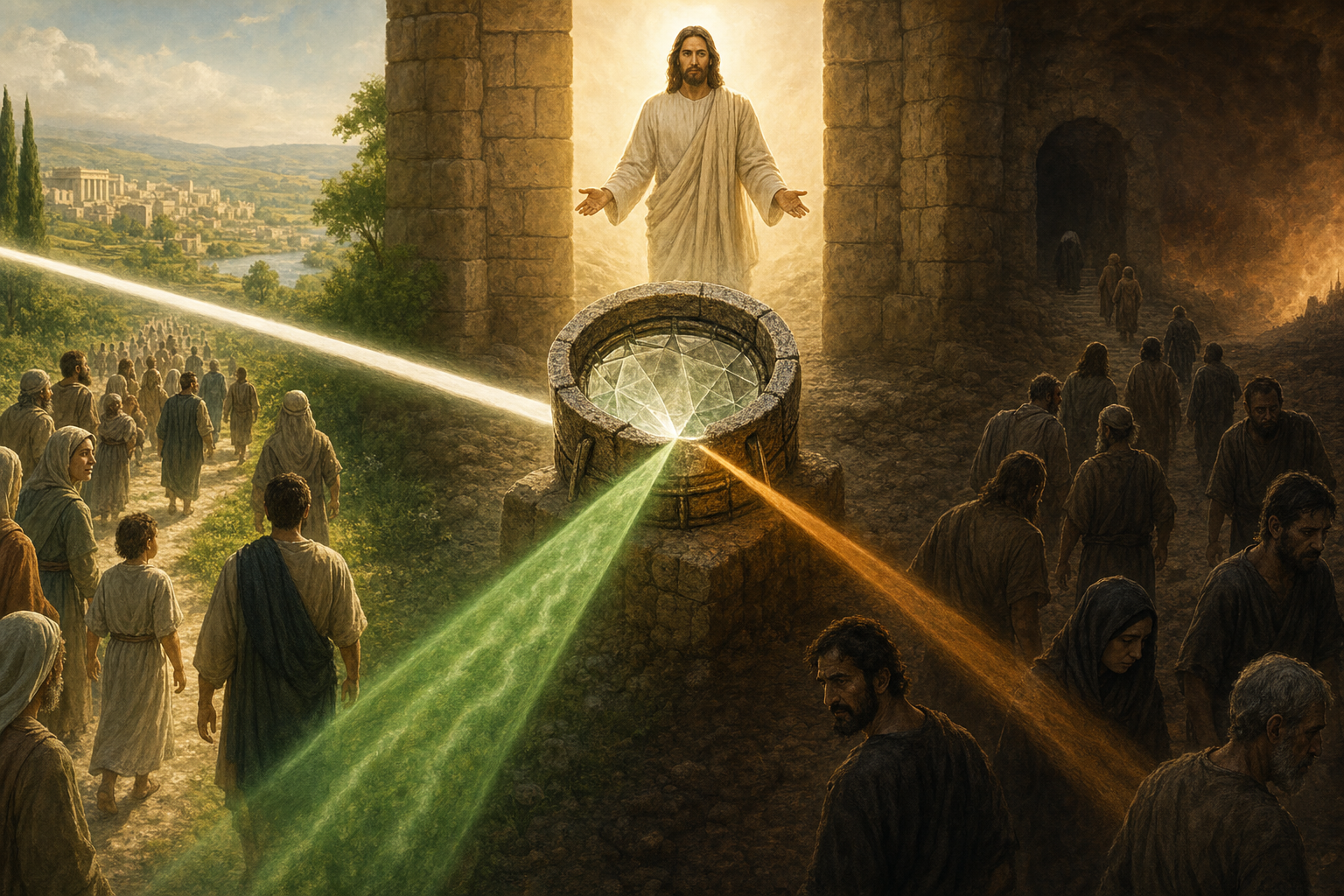
Bible Study · John’s Gospel · Greek vocabulary
Krisis in John’s Gospel: Greek Verdict Vocabulary and the Split Over Jesus
Every meeting with Jesus forces a verdict — John names that sorting with κρίσις (krisis), schisma, and pisteuō.
Jump to a section
- ⚖️ Verdict flow
- Plain English
- Three Greek words
- Krinō / Krisis / Krima
- Schisma
- Pisteuō
- Prologue template
- John 3:16–21
- Sign by sign
- Egō eimi
- John 9
- John 12
- Vocabulary map
- Knowledge strand
- Knowledge (+)
- Ignorance (−)
- John 4:10
- “We know” pole
- Jesus knows
- Akouō
- Characters
- Lawsuit structure
- Scholars
- Complications
- Verse grid
- Summary
- Takeaway
Reading guide: Green = load-bearing truth · Gold = precious outcome · Rust = refusal / judgment pole · Teal = hearing / knowing · bold = key terms · expand ▸ rows and flip cards · anchor verses 3:19 and 5:24 frame the study.
In one sentence: Every meeting with Jesus forces a verdict — and John names that sorting with the Greek word krisis.
Watch for: The colour legend and anchor verses (3:19, 5:24) — they frame the whole study.
In John’s Gospel every person who meets Jesus walks away carrying a verdict, and the Greek word for that verdict is κρίσις (krisis) — a word that means “separation” before it ever means “judgment”.
John 3:19 (NKJV)
And this is the condemnation (krisis), that the light has come into the world, and men loved darkness rather than light, because their deeds were evil.
John 5:24 (NKJV)
Most assuredly, I say to you, he who hears My word and believes in Him who sent Me has everlasting life, and shall not come into judgment, but has passed from death into life (metabebēken — crossed over).
⚖️ The Verdict Flow
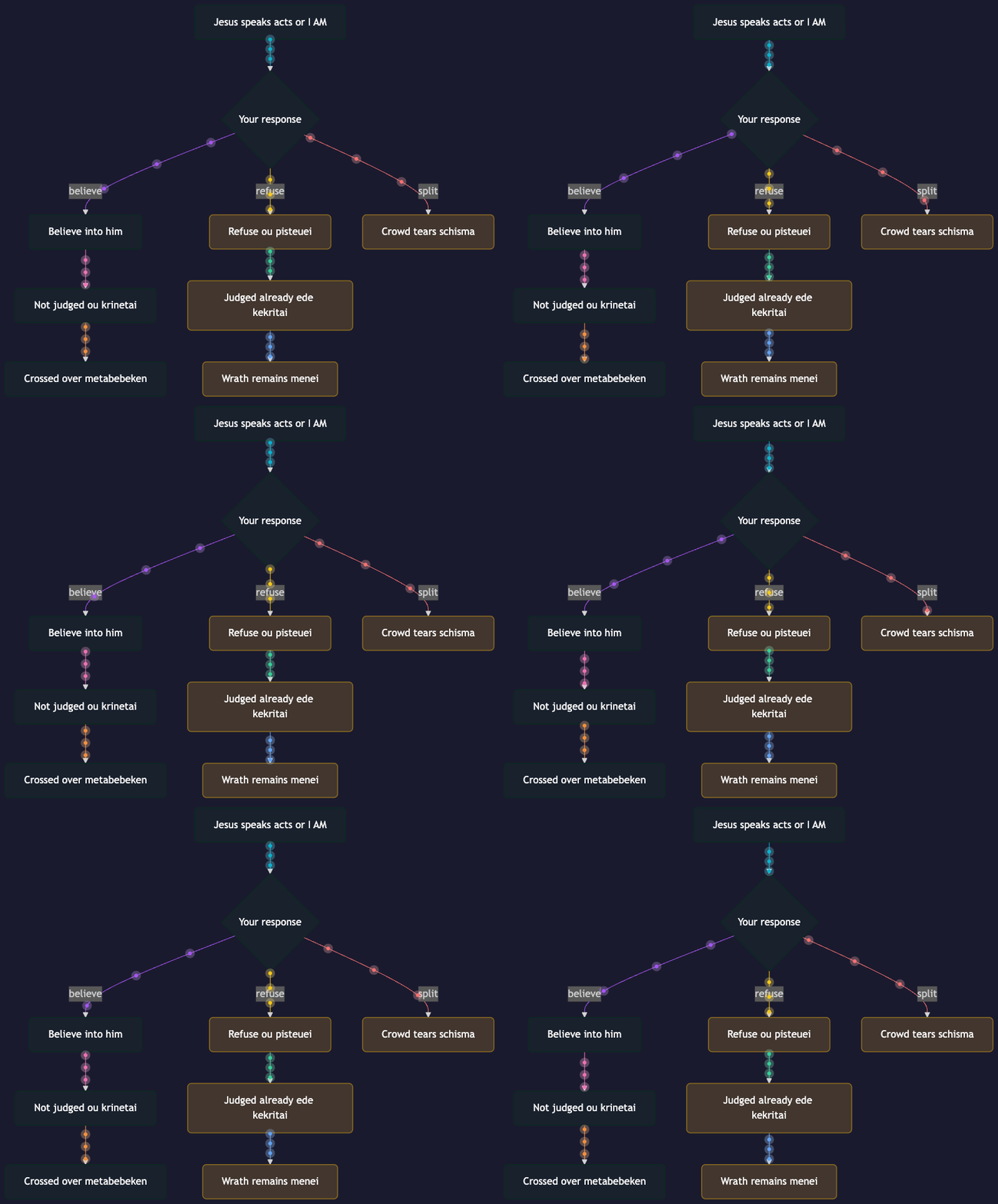
Animated verdict flow — believe, refuse, or crowd split.
In one sentence: Jesus speaks, acts, or claims I AM — and every listener lands on believe, refuse, or a torn crowd.
Watch for: Perfect tenses — outcomes are already settled, not only future.
Jesus speaks, acts, or says egō eimi — and every encounter forces a response. That response is the krisis:
| Response | Greek | Outcome | Verse |
|---|---|---|---|
| Believes into him | pisteuo eis auton | ou krinetai — not judged → metabebeken (crossed from death to life) | John 3:18; 5:24 |
| Refuses | ou pisteuei | ede kekritai — judged already → menei hē orgē (wrath remains) | John 3:18; 3:36 |
| Crowd splits | schisma | The people tear — divided response | John 7:43; 9:16; 10:19 |
🙂 Plain English: What Is Krisis in John?
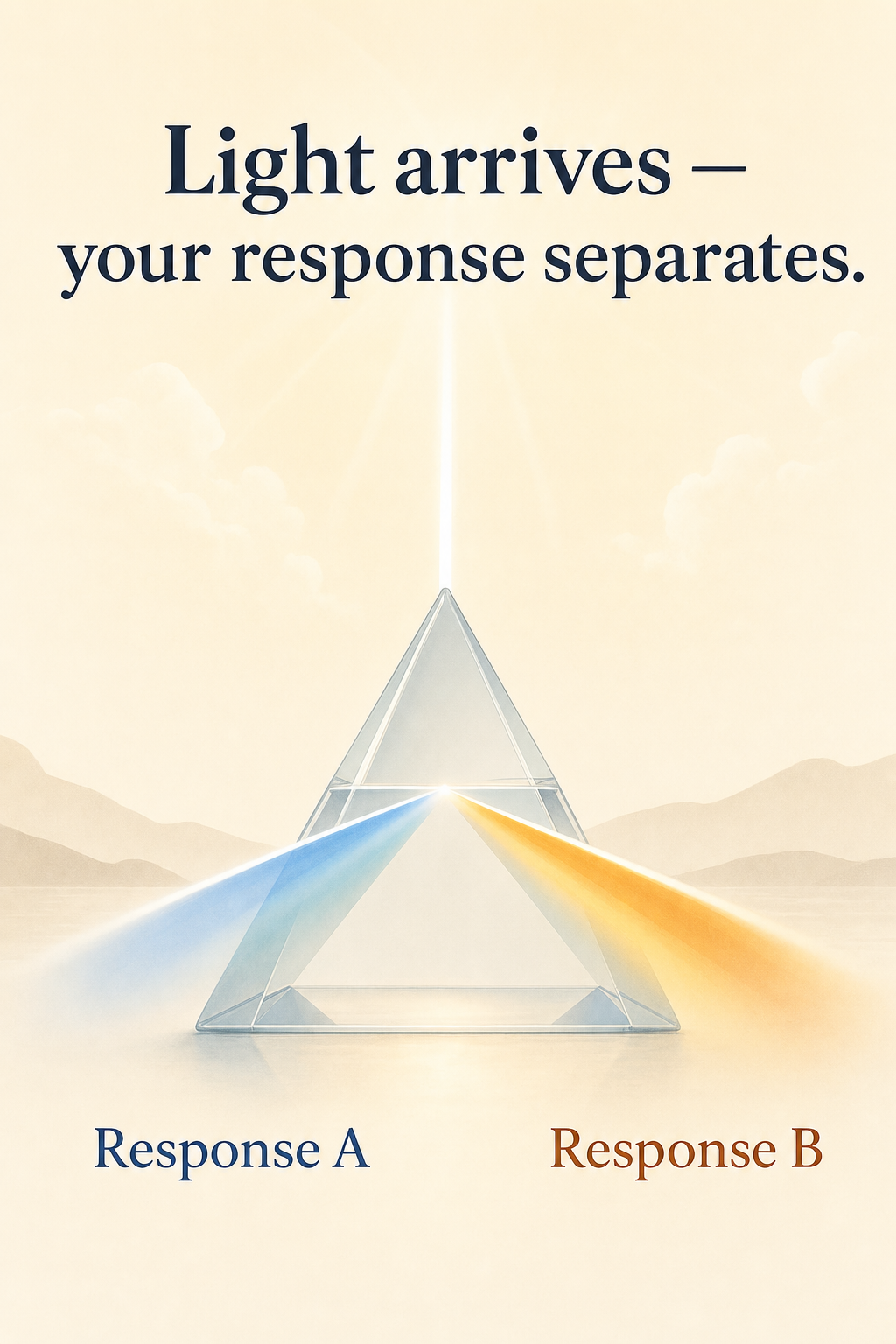
Krisis works like light through glass — arrival separates; response supplies the sign.
In one sentence: Krisis is neutral — like a sieve or prism — and your response to Jesus supplies the sign.
Watch for: The FAQ rows on knowing (17:3, 4:10) — a third strand beside light/dark and believe/refuse.
Short version: Jesus does not arrive and then judge — his arrival is the sieve. The word John uses for that sieving is the same word English borrowed twice, as “crisis” and as “critic”.
| Question | Answer |
|---|---|
| What is the Greek word? | κρίσις (krisis) — judgment, separation, turning point |
| What is the verb behind it? | κρίνω (krinō) — to separate, sift, distinguish, then to judge |
| Where does the root come from? | PIE root meaning to separate, sift or sieve — the same root behind “criterion” and “critic” |
| Is the word positive or negative? | Neutral. Your response to Jesus supplies the sign |
| What is the word for the visible split? | σχίσμα (schisma) — a tear, used of people only by John |
| What is the word for the positive response? | πιστεύω εἰς (pisteuō eis) — to believe into him |
| When does the verdict happen? | Now. Perfect tense: “has been judged already” (John 3:18) |
| What do scholars call the whole pattern? | Johannine dualism; specifically Bultmann’s Entscheidungsdualismus — “dualism of decision” |
| Is Jesus the judge or the defendant? | Both — that is the irony John builds the trial scenes on (John 18–19) |
| Does knowing Jesus belong to this pattern? | Yes — γινώσκω / οἶδα form a third strand alongside light/darkness and sight/blindness |
| Is knowledge the reward, or the route? | Both collapse: John 17:3 defines eternal life as knowing the Father and the Son |
| What does not-knowing cost? | John 4:10 — she did not know the gift, so she did not ask, so she did not receive |
| Key verse to memorise | John 3:19 — “this is the krisis: the light has come into the world” |
| Second verse to memorise | John 17:3 — “this is eternal life: that they know you” |
| Common reading | What John’s Greek says | |
|---|---|---|
| Old way | Judgment is a future courtroom at the end of time | Judgment is a present state, already settled (3:18, 5:24) |
| Old way | God condemns the unbeliever | The unbeliever pronounces sentence on himself by preferring darkness (3:19) |
| Old way | People are divided into two fixed types | People become light or darkness by the decision they make about Jesus |
| New way | Faith is a noun you possess | John never uses the noun pistis — only the verb, 98 times |
| Analogy | A courtroom with a distant date | A prism: one beam of white light enters, and the glass separates it — the light did nothing but arrive |
| Analogy | A test you pass or fail | An X-ray: the beam does not create the fracture, it exposes what was already there (3:20–21) |
🔤 Three Greek Words That Carry the Split
In one sentence: Five words (krinō, krisis, krima, schisma, pisteuō) carry almost the whole pattern.
Watch for: Krima appears only once (9:39) — the concrete sentence, not the process.
There is no single technical term — the pattern rides on a small cluster of words. Learn these five and the whole Gospel opens.
| Greek | Translit. | Strong’s | Sense in John | Key verses |
|---|---|---|---|---|
| κρίνω | krinō | G2919 | separate, distinguish, then judge | 3:17; 5:22, 30; 8:15–16; 12:47–48 |
| κρίσις | krisis | G2920 | the act/process of separation; the verdict event | 3:19; 5:22, 24, 27, 29, 30; 7:24; 8:16; 12:31; 16:8, 11 |
| κρίμα | krima | G2917 | the concrete sentence — only once in John | 9:39 |
| σχίσμα | schisma | G4978 | a tear, a rupture in the crowd | 7:43; 9:16; 10:19 |
| πιστεύω | pisteuō | G4100 | believe, trust, entrust oneself — 98x | 1:12; 3:16; 6:29; 11:25–27; 20:31 |
The root matters. Krinō comes from an ancient root meaning to separate, sift or sieve; the noun krisis carried the sense of a turning point — potentially between life and death — long before any courtroom borrowed it.
📜 Krinō, Krisis, Krima — Verdict Vocabulary
In one sentence: Jesus both refuses and accepts the judge role — the paradox is deliberate.
Watch for: 12:31 — the cross is the world’s krisis.
Every one of these is spoken by Jesus except the narrator’s frame in 3:19. Note how he refuses the role and takes it at the same time.
| Verse | Jesus says | Greek force |
|---|---|---|
| John 3:17 | God did not send the Son to judge the world, but that the world be saved through him | hina krinē — purpose denied |
| John 3:18 | The one believing is not judged; the one not believing has been judged already | ēdē kekritai — perfect passive, settled state |
| John 3:19 | This is the krisis: the light has come, and men loved the darkness | hautē estin hē krisis — the verdict is the arrival |
| John 5:22 | The Father judges no one but has given all judgment to the Son | tēn krisin pasan dedōken |
| John 5:24 | Hears my word and believes → does not come into krisis, has crossed over from death to life | metabebēken — perfect, already crossed |
| John 5:27 | He gave him authority to execute krisis, because he is Son of Man | Daniel 7:13 echo |
| John 5:29 | Resurrection of life vs resurrection of krisis | the two outcomes named side by side |
| John 8:15–16 | You judge according to the flesh; I judge no one — yet if I do judge, my krisis is true | deliberate paradox |
| John 9:39 | For krima I came into this world: that the non-seeing may see and the seeing become blind | only krima in John — the sentence, not the process |
| John 12:31 | Now is the krisis of this world; now the ruler of this world will be cast out | the cross is the verdict |
| John 12:47–48 | I do not judge him — the word I spoke will judge him on the last day | the word becomes the judge |
| John 16:8, 11 | The Paraclete will convict the world concerning sin, righteousness and krisis | the lawsuit continues after the ascension |
On John 9:39 the shift of word is deliberate. Commentators note that this particular form is used nowhere else by John, and points not to the act of judging but to the concrete result — the sentence pronounced. A UBS translators’ handbook renders the sense of the verse as coming into the world “to be a means of dividing up people”. One Byzantine reader, Nonnus, called it a twofold judgment, the two halves running in opposite directions.
✂️ Schisma — The Three Times the Crowd Tears
In one sentence: Schisma is what krisis looks like from outside — the crowd tearing three times.
Watch for: Word, work, claim — the same seam every time.
If krisis is the invisible verdict, schisma is what it looks like from outside. The statistic is striking: John is the only evangelist who applies the “tearing” word to human beings.
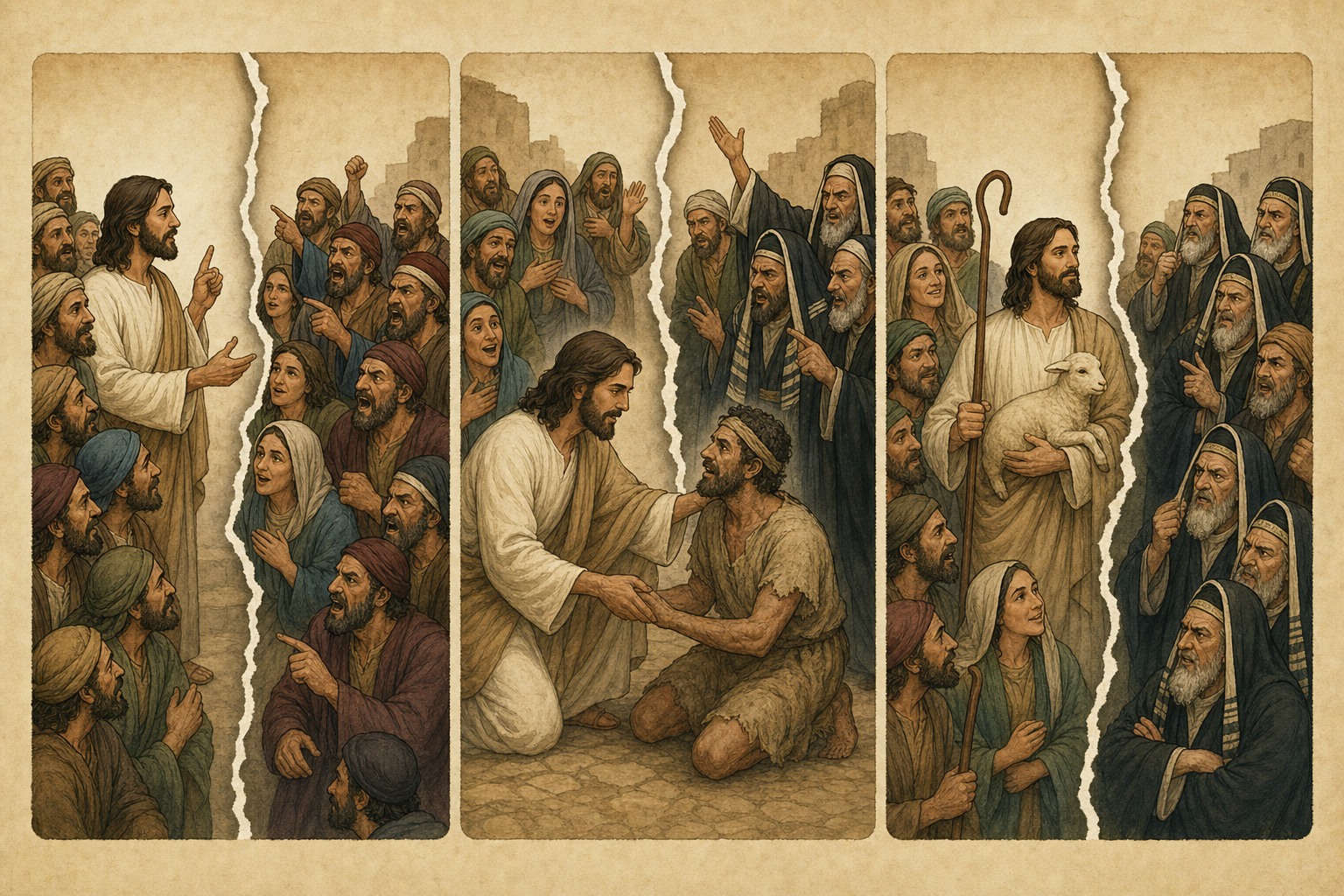
Schisma is what krisis looks like from outside — the crowd tears along word, work, and claim.
John 7:43 (NKJV)
So there was a division (schisma) among the people because of Him.
| Verse | Trigger | Positive side | Negative side |
|---|---|---|---|
| John 7:40–43 | A word — the Tabernacles cry, “let him come to me and drink” (7:37) | “This is truly the Prophet” / “This is the Christ” | “Does the Christ come out of Galilee?” — some wanted to seize him (7:44) |
| John 9:16 | A work — mud, Siloam, sight on a Sabbath | “How can a sinful man do such signs?” | “This man is not from God, he does not keep the Sabbath” |
| John 10:19–21 | A claim — “I am the good shepherd… I and the Father are one” (10:11, 30) | “These are not the words of one demon-possessed; can a demon open blind eyes?” | “He has a demon and is mad; why listen to him?” |
| schisma across the NT | Usage |
|---|---|
| Matthew 9:16; Mark 2:21 | Literal — a patch tearing away from a garment |
| John 7:43; 9:16; 10:19 | Metaphorical — a crowd torn by its response to Jesus |
| 1 Corinthians 1:10; 11:18; 12:25 | Metaphorical — factions in a church |
| Total NT occurrences | 8 |
Note the pattern in column two of the first table: word, work, claim. Whichever way Jesus reveals himself, the tear opens along the same seam.
🙏 Pisteuō — 98 Verbs and Zero Nouns
In one sentence: John uses believe as a verb 98 times and never the noun pistis — faith is something you do.
Watch for: The faith/knowledge symmetry table — both nouns are zero.
John’s positive pole is never a possession. It is always something you do toward a person.
| Form | Greek | Count in John | Count in NT |
|---|---|---|---|
| Verb “believe” | πιστεύω pisteuō | 98 (more than all three Synoptics combined) | 241 |
| Noun “faith” | πίστις pistis | 0 | 243 |
| Adjective “believing” | πιστός pistos | 1 (20:27) | 67 |
| Adjective “unbelieving” | ἄπιστος apistos | 1 (20:27) | — |
| Construction | Meaning | Example |
|---|---|---|
| pisteuō eis + accusative | believe into — entrust yourself to a person | 1:12; 3:16; 11:25; 14:1 |
| pisteuō + dative | believe a statement / credit someone’s word | 5:24 (believes him who sent me) |
| pisteuō hoti | believe that — propositional | 11:27; 20:31 |
| pisteuō absolute | simply “believed” | 4:41; 20:8 |
The negative pole gets its own verb in John 3:36: not merely ou pisteuōn but ὁ ἀπειθῶν (ho apeithōn) — the one who refuses or disobeys. And the outcome verb there is menei, “remains” — the wrath is not newly applied, it is what stays when the light is refused.
John makes the same grammatical decision twice, and the symmetry is the strongest structural clue in the book.
| Theme | Verb usage in John | Noun usage in John | Implication |
|---|---|---|---|
| Faith | πιστεύω — 98x | πίστις — 0x | Faith is never a possession |
| Knowledge | γινώσκω + οἶδα — roughly 140x combined | γνῶσις — 0x | Knowledge is never a commodity |
That second zero is pointed. Gnōsis was the prestige word of the religious marketplace John was writing into; he floods his Gospel with knowing and refuses the noun the mystical systems were built on. In John nobody attains knowledge — it is disclosed (1:18; 15:15; 17:6, 26).
📖 The Prologue Sets the Template: John 1:9–13
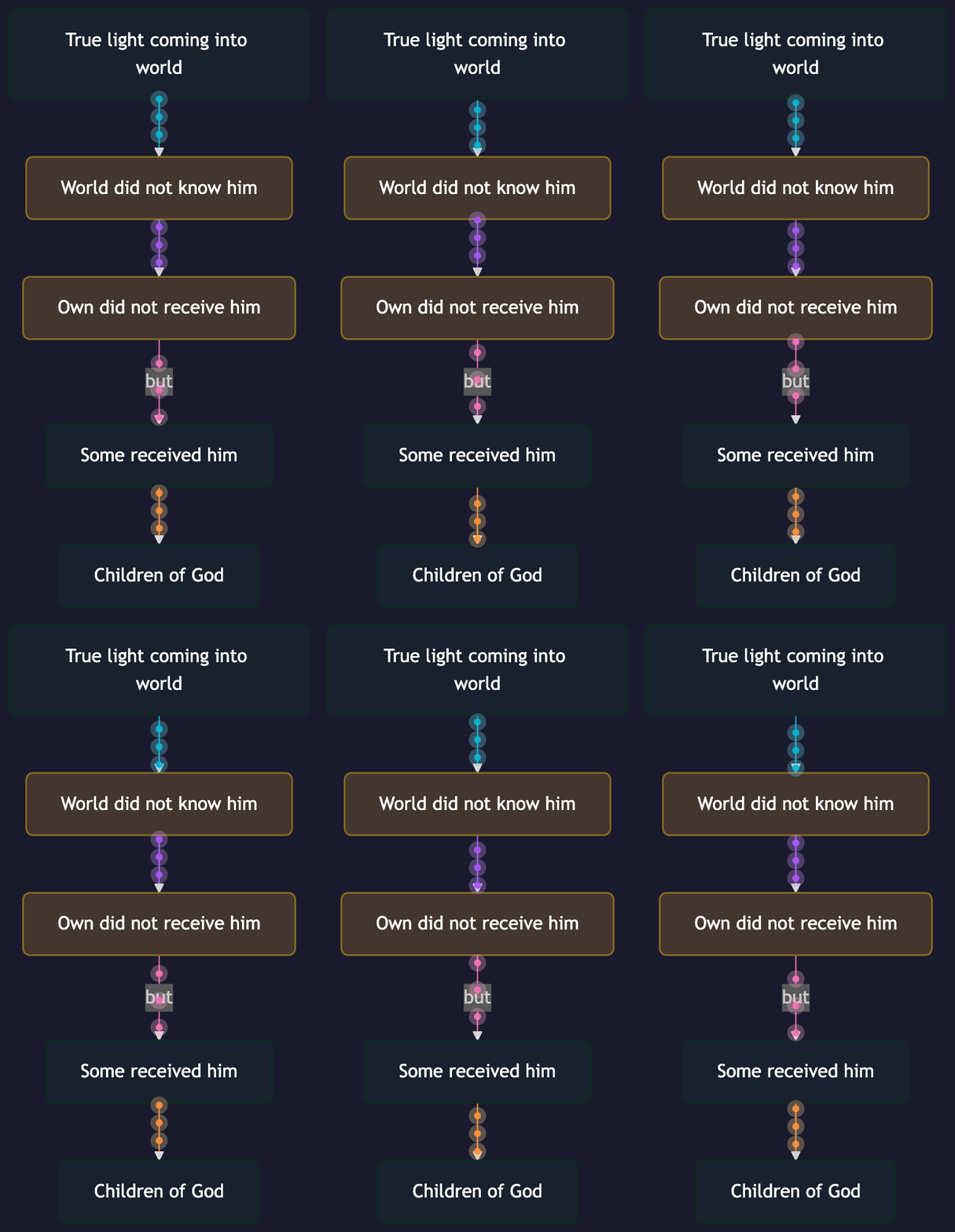
Animated prologue template from John 1:9–13.
In one sentence: John 1:9–13 is the template — light comes, some refuse, some receive, children of God follow.
Watch for: Two different Greek verbs for “receive” in 1:11 vs 1:12.
Everything from chapter 2 onward is a case study of these five verses. Two different Greek verbs for “receive” sit back to back.
| Verse | Text | Greek | Pole |
|---|---|---|---|
| 1:9 | The true light… was coming into the world | to phōs to alēthinon | the trigger |
| 1:10 | The world did not know him | ouk egnō | negative |
| 1:11 | He came to his own, and his own did not receive him | ou parelabon — did not welcome/take alongside | negative |
| 1:12a | But as many as received him | elabon — took hold, active | positive |
| 1:12b | He gave them authority to become children of God | exousian… tekna theou | positive outcome |
| 1:13 | Born not of blood, nor flesh, nor man’s will, but of God | ek theou egennēthēsan | positive origin |
D. A. Carson reads verses 11–13 as a small chiasm, with 1:11 paralleling 1:13 and 1:12a paralleling 1:12c, so that “he gave them the right to become children of God” stands as the pivot. Craig Keener notes that the phrase “believing in his name” appears at only a few strategic points — 1:12; 2:23; 3:18; 20:31 — forming an inclusio between the prologue and the purpose statement.
%%{init: {"theme": "base", "themeVariables": {"background": "transparent", "lineColor": "#444444"}}}%%
flowchart TD
    A["Light comes into the world"] --> B{"Receive the light?"}
    B -->|Yes| C["Become children of God"]
    B -->|No| D["Remain outside — own authority"]
    E["Believe in his name"] --> C
    F["Born of God — not blood or will"] --> C
    class A,E,F truth
    class C outcome
    class D split

classDef truth fill:#bbf7d0,stroke:#16a34a,color:#14532d
classDef outcome fill:#fde68a,stroke:#ca8a04,color:#92400e
classDef split fill:#fecaca,stroke:#991b1b,color:#991b1b
classDef neutral fill:#e0e7ff,stroke:#34558b,color:#1e3a8a
John 1:9–13 templates the whole Gospel: arrival is neutral; receiving the light is what moves someone onto the children-of-God pole.
💡 John 3:16–21 — The Verdict Is Already In
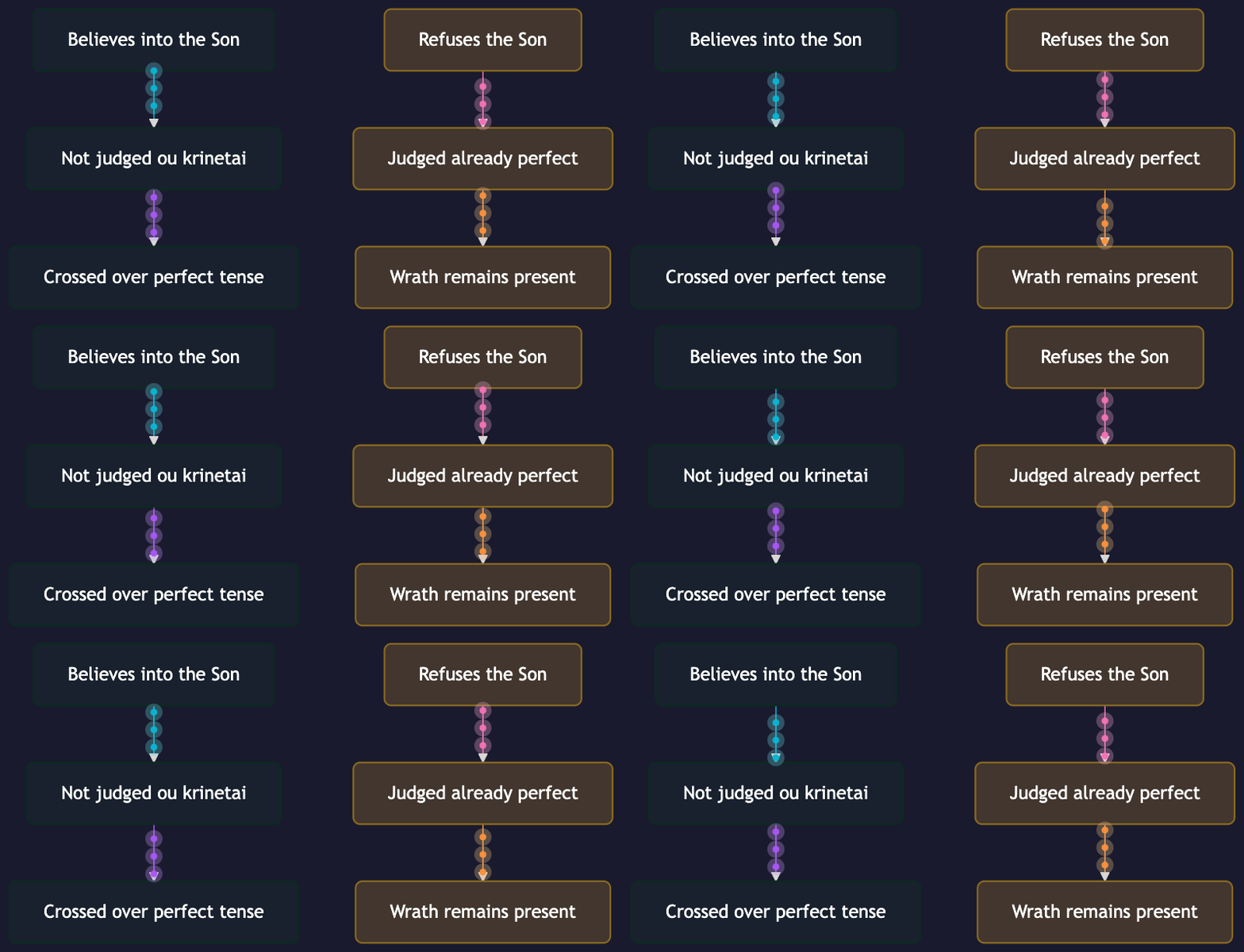
Animated tense map for John 3 — already judged, crossed over, wrath remains.
In one sentence: The verdict is already in — watch the tenses, not just the ideas.
Watch for: 3:19 defines krisis as preferring darkness when light arrived.
Watch the tenses. Nothing here is deferred.
John 3:18–19 (NKJV)
He who believes in Him is not condemned; but he who does not believe is condemned already, because he has not believed in the name of the only begotten Son of God. And this is the condemnation, that the light has come into the world, and men loved darkness rather than light, because their deeds were evil.
| Verse | Positive clause | Negative clause | Tense signal |
|---|---|---|---|
| 3:16 | whoever believes… has eternal life | should not perish (apolētai) | present possession |
| 3:18 | is not judged (ou krinetai) | has been judged already (ēdē kekritai) | perfect passive |
| 3:19 | — | loved the darkness rather than the light | aorist — a settled preference |
| 3:20 | — | hates the light, does not come to it, lest his works be exposed | present habitual |
| 3:21 | does the truth, comes to the light | — | present habitual |
| 3:36 | believes → has eternal life | refuses (apeithōn) → shall not see life; the wrath remains (menei) | present + present |
3:19 is the definition verse: the krisis is not a sentence God hands down later, it is the fact that the light arrived and people chose. 3:20–21 supplies the motive — exposure. The light is refused not because it is dim but because it is bright.
🪧 Sign by Sign: The Divided-Response Ledger
In one sentence: All seven pre-cross signs divide the crowd — never a single unified reaction.
Watch for: Lazarus (sign 7) produces the plot to kill Jesus.
John records seven signs before the cross. Not one of them produces a single, unified reaction.
| # | Sign | Ref | Positive response | Negative response |
|---|---|---|---|---|
| 1 | Water into wine | 2:1–11 | His disciples believed in him (2:11) | The steward credits the bridegroom — the sign is missed (2:9–10) |
| 2 | Official’s son healed | 4:46–54 | He and his whole household believed (4:53) | Jesus rebukes sign-dependent faith: “unless you see signs you will not believe” (4:48) |
| 3 | Paralytic at Bethesda | 5:1–15 | The man is healed and told to sin no more (5:14) | The Jews persecute Jesus and seek to kill him (5:16, 18) |
| 4 | Feeding of the 5,000 | 6:1–15 | “This is truly the Prophet” (6:14) | They try to seize him and make him king (6:15); later “many of his disciples went back” (6:66) |
| 5 | Walking on water | 6:16–21 | They were willing to take him into the boat (6:21) | The crowd next day only wants more bread (6:26) |
| 6 | Man born blind | 9:1–41 | “Lord, I believe” — and he worshipped him (9:38) | schisma among the Pharisees (9:16); the man is expelled (9:34); “your sin remains” (9:41) |
| 7 | Raising of Lazarus | 11:1–44 | Many of the Jews believed in him (11:45) | Some went to the Pharisees (11:46) → the council resolves to kill him (11:53) |
Sign 7 is the sharpest case. The greatest sign — a four-day-dead man walking — produces the greatest split, and the plot to kill Jesus is the direct consequence. Commentators note there is never a neutral reaction to Jesus in this Gospel; the miracles always divided.
⚡ Egō Eimi — The Sharpest Edge
In one sentence: Absolute “I AM” claims draw the sharpest responses in the book.
Watch for: Stones, falling back, Judas going out “and it was night.”
The phrase occurs about 24 times in John, of which seven are absolute — no predicate, no “the bread”, no “the door”, just the divine name. These produce the most violent responses in the book.
| Ref | Absolute “I AM” | Immediate response | |
|---|---|---|---|
| 8:24 | Unless you believe that egō eimi, you will die in your sins | “Who are you?” (8:25) | |
| 8:28 | When you have lifted up the Son of Man, then you will know that egō eimi | Many believed in him (8:30) — then argue and are told they are of their father the devil (8:44) | |
| 8:58 | Before Abraham came to be, egō eimi | They picked up stones to throw at him (8:59) | |
| 13:19 | When it happens you may believe that egō eimi | Judas goes out — “and it was night” (13:30) | |
| 18:5 | Egō eimi — to the arresting cohort | Judas is standing with them | |
| 17:3 | Knows the only true God and Jesus Christ | This is eternal life | + |
| 17:25 | The world has not known you | “But I have known you, and these have known that you sent me” | ± |
| 18:6 | Egō eimi repeated by the narrator | They drew back and fell to the ground | |
| 18:8 | I told you that egō eimi — let these go | The arrest proceeds on Jesus’ terms |
| Predicate “I AM” saying | Ref | Positive pole offered | Negative pole implied |
|---|---|---|---|
| I am the bread of life | 6:35 | never hunger, never thirst | 6:66 — many disciples walk away |
| I am the light of the world | 8:12 | will not walk in darkness | 8:13 — “your testimony is not true” |
| I am the door | 10:9 | will be saved, will go in and out and find pasture | 10:8 — thieves and robbers |
| I am the good shepherd | 10:11 | lays down his life for the sheep | 10:20 — “he has a demon” |
| I am the resurrection and the life | 11:25 | though he die, yet shall he live | 11:46 — informers go to the Pharisees |
| I am the way, the truth, the life | 14:6 | no one comes to the Father except through me | the exclusivity is itself the dividing edge |
| I am the true vine | 15:1 | abides, bears much fruit (15:5) | 15:6 — cast out, withers, burned |
👁️ John 9: The Whole Mechanism Acted Out in One Chapter
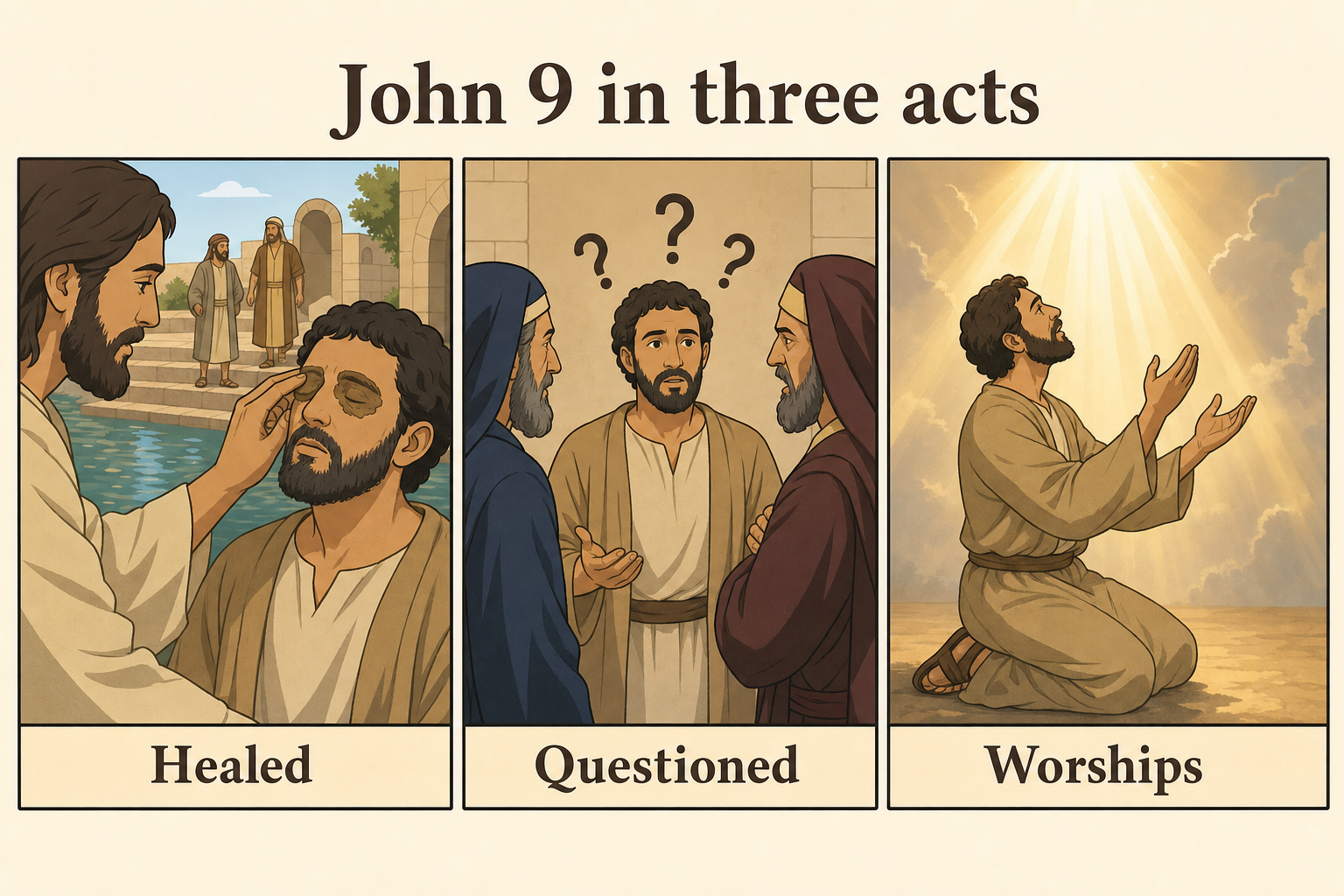
One chapter, three acts — healed, questioned, worships.
In one sentence: Chapter 9 acts out the whole machine — schisma, krima, “we know,” worship.
Watch for: Honest “I do not know” ends in worship; confident “we know” ends in blindness.
Chapter 9 is the krisis pattern dramatised. Track the two lines: one man’s sight and confession rise step by step; the leaders’ sight collapses step by step.
| Verse | The blind man’s confession | The Pharisees’ position |
|---|---|---|
| 9:11 | “The man called Jesus” | — |
| 9:16 | — | schisma — “not from God” vs “how can a sinner do such signs?” |
| 9:17 | “He is a prophet” | They did not believe he had been blind (9:18) |
| 9:22 | — | Already agreed: confess him as Christ → put out of the synagogue |
| 9:24 | — | “We know that this man is a sinner” |
| 9:25 | “One thing I know: I was blind, now I see” | — |
| 9:31–33 | “If this man were not from God, he could do nothing” | “You were born entirely in sins, and you teach us?” (9:34) |
| 9:34 | — | They cast him out (exebalon exō) |
| 9:38 | “Lord, I believe” — and he worshipped him | — |
| 9:39 | — | Jesus: for krima I came — non-seeing see, seeing become blind |
| 9:40–41 | — | “Are we blind too?” → “now you say ‘we see’, your sin remains” (menei) |
The chapter ends with the same verb as 3:36 — menei, “remains”. Nothing new is inflicted; what is refused simply stays.
🌍 John 12:31–50 — The Verdict on the World
In one sentence: Passion week is the verdict on the world — cross, Isaiah, secret believers.
Watch for: 12:42–43 — belief without confession is its own category.
The Book of Signs closes by naming the whole problem out loud, with two Isaiah quotations.
| Verse | Content | Function |
|---|---|---|
| 12:31 | Now is the krisis of this world; now the ruler of this world is cast out | The cross is the courtroom |
| 12:32 | “I, if I am lifted up, will draw all to myself” | The same lifting up is both verdict and rescue |
| 12:37 | Though he had done so many signs before them, they were not believing in him | The ledger closed on the public ministry |
| 12:38 | Isaiah 53:1 — “who has believed our report?” | Rejection was foretold in the Servant Song |
| 12:39–40 | Isaiah 6:10 — blinded eyes, hardened heart | “They could not believe” — first would not, then could not |
| 12:41 | Isaiah said these things when he saw his glory | John identifies the enthroned LORD of Isaiah 6 with Jesus |
| 12:42 | Many even of the rulers believed — but would not confess, for fear of the synagogue | A third category: secret belief that stops short of confession |
| 12:43 | They loved the glory of men more than the glory of God | The motive named — same shape as 3:19 “loved the darkness” |
| 12:47 | “I do not judge him — I came to save the world” | Purpose restated from 3:17 |
| 12:48 | “The word I spoke will judge him on the last day” | Future krisis retained alongside present krisis |
John explicitly names Isaiah in 12:38, 39 and 41 — unusual for him, since he normally omits the biblical author’s name. Both halves of Isaiah are quoted, framing Jesus as the rejected Servant and the enthroned Lord in the same breath.
📊 The Paired Vocabulary Map
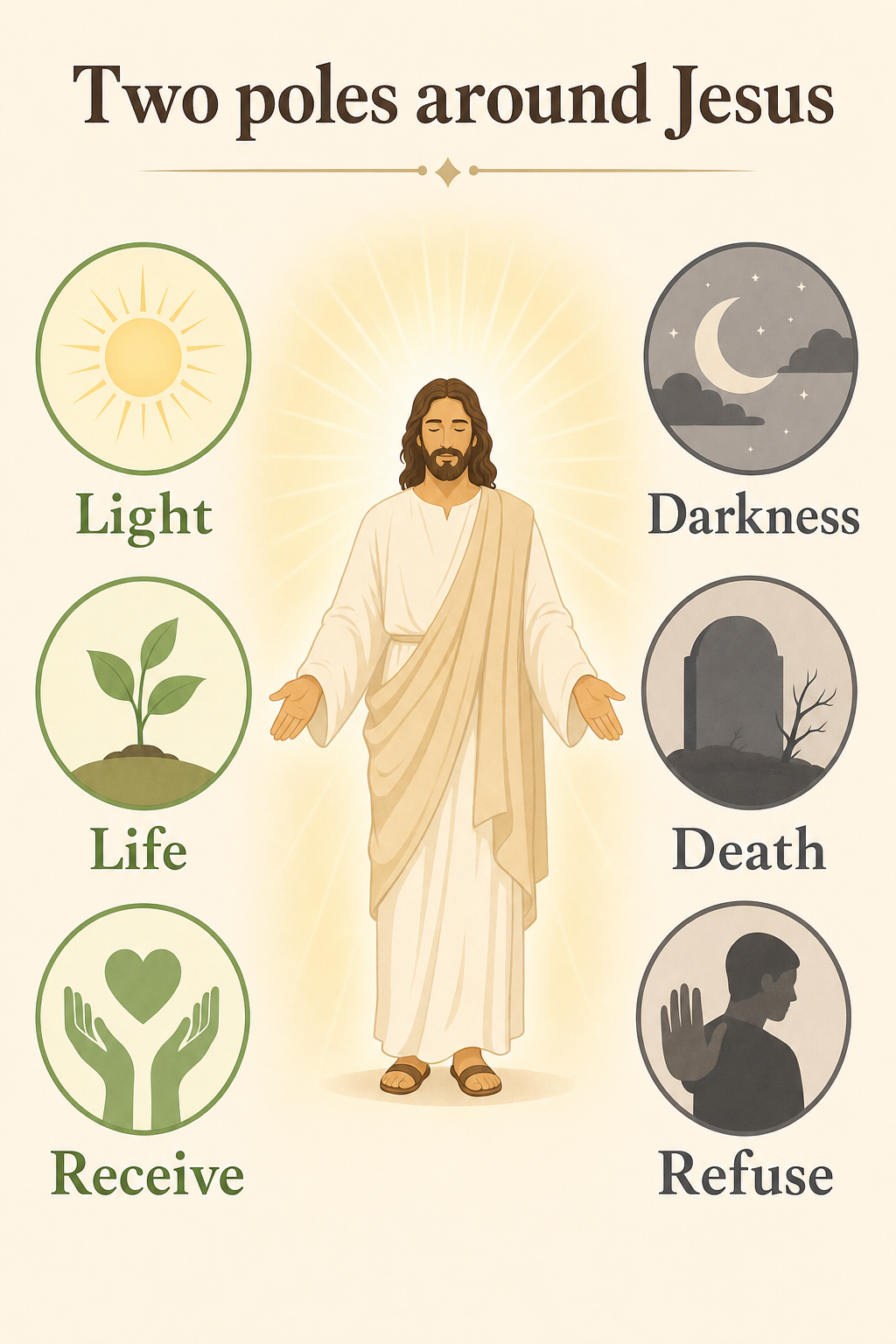
Johannine pairs run in two columns — moral categories, not fixed natures.
In one sentence: John’s pairs (light/dark, receive/refuse, hear/cannot hear) are moral, not Greek philosophy.
Watch for: Time of day staging — night, noon, “it was night.”
Once the mechanism is clear, John’s whole word-stock lines up in two columns. This is what scholars mean by Johannine dualism — moral and ethical, not the ontological dualism of Greek philosophy where matter itself is evil.
| Category | Positive pole (Greek) | Ref | Negative pole (Greek) | Ref |
|---|---|---|---|---|
| Reception | ἔλαβον elabon — received | 1:12 | οὐ παρέλαβον ou parelabon | 1:11 |
| Illumination | φῶς phōs — light | 8:12 | σκοτία skotia — darkness | 3:19; 12:35 |
| Life | ζωὴ αἰώνιος zōē aiōnios | 3:16 | ἀπόλλυμι apollumi — perish; ὀργή orgē | 3:16, 36 |
| Verdict | οὐ κρίνεται ou krinetai | 3:18 | ἤδη κέκριται ēdē kekritai | 3:18 |
| Sight | βλέπω blepō — sees | 9:25 | τυφλός typhlos — blind | 9:39–41 |
| Movement | μεταβέβηκεν metabebēken — has crossed over | 5:24 | μένει menei — remains (in wrath, in sin) | 3:36; 9:41 |
| Resurrection | ἀνάστασις ζωῆς — of life | 5:29 | ἀνάστασις κρίσεως — of judgment | 5:29 |
| Origin | ἐκ τοῦ θεοῦ ek tou theou | 8:47 | ἐκ τῶν κάτω ek tōn katō — from below | 8:23 |
| Position | μένει ἐν ἐμοί menei en emoi — abides | 15:4–5 | ἐβλήθη ἔξω eblēthē exō — cast out | 15:6 |
| Time of day | ἡμέρα hēmera — day; noon | 11:9; 4:6 | νύξ nyx — night | 3:2; 13:30 |
| Truth | ἀλήθεια alētheia | 8:32; 14:6 | ψεῦδος pseudos; the liar | 8:44 |
| Knowledge | γινώσκω ginōskō — knows him | 10:14; 17:3 | οὐκ ἔγνω ouk egnō — did not know him | 1:10; 16:3; 17:25 |
| Disclosure | γνωρίζω gnōrizō — made known | 15:15; 17:26 | οὐκ οἴδατε ouk oidate — you do not know | 1:26; 4:22; 8:19 |
| Hearing | ἀκούει τὴν φωνήν — hears his voice | 5:24; 10:3, 27 | οὐ δύνασθε ἀκούειν — cannot hear my word | 8:43, 47 |
| Kinship | τέκνα θεοῦ — children of God | 1:12 | ἐκ τοῦ πατρὸς τοῦ διαβόλου | 8:44 |
| Origin above/below | ἄνωθεν anōthen — from above | 3:3, 31 | ἐκ τοῦ κόσμου — of this world | 8:23 |
| Gathering | συναγάγῃ εἰς ἕν — gather into one | 11:52 | σκορπίζει — scatters | 10:12 |
Note the staging, not just the vocabulary. Nicodemus comes at night (3:2); the Samaritan woman meets Jesus at noon (4:6); Judas goes out, “and it was night” (13:30). The lighting is theology.
🧠 The Knowledge Strand: γινώσκω and οἶδα
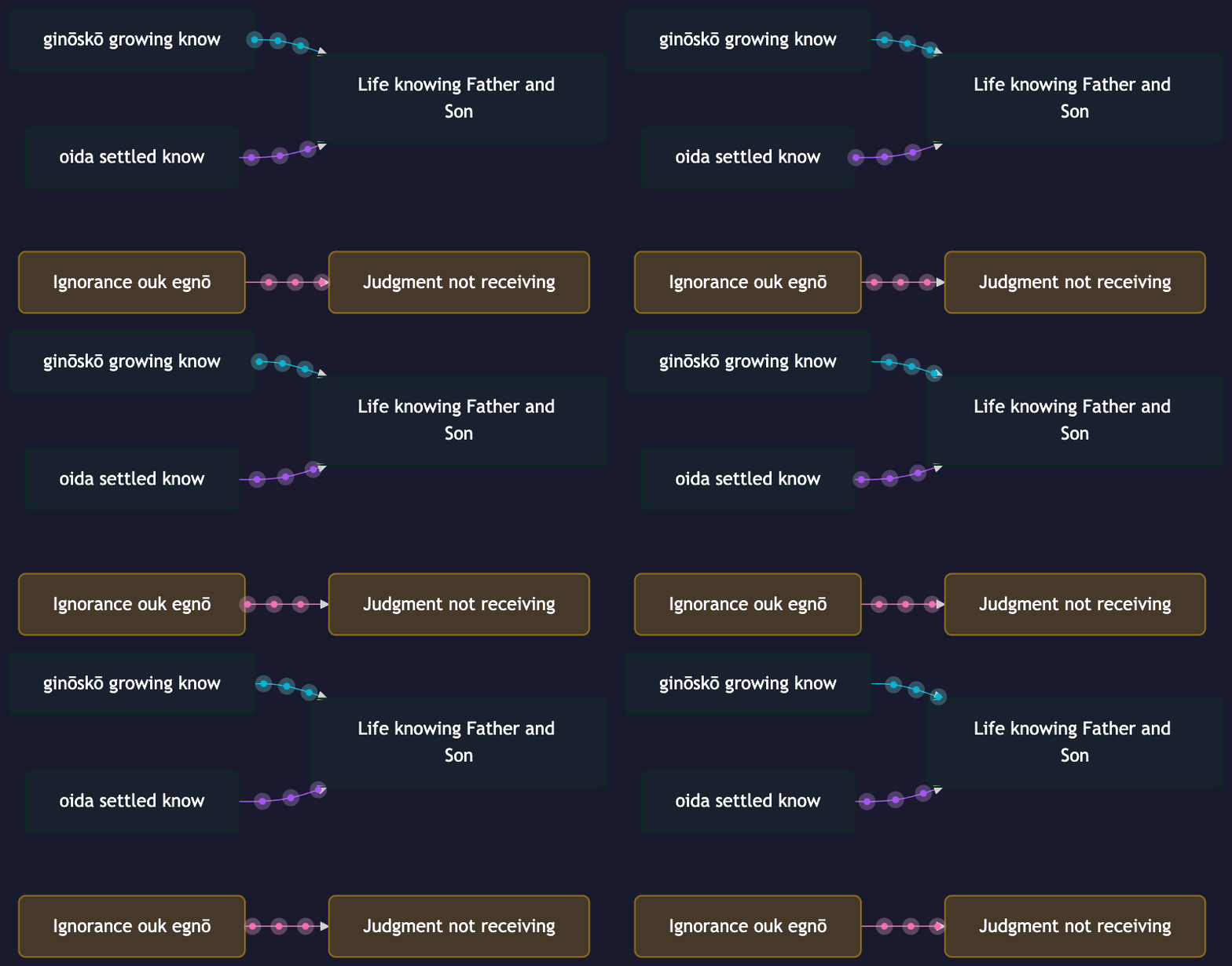
Animated knowledge strand — growing know, settled know, ignorance.
In one sentence: Knowing is a third axis — ginōskō and oida — with gnōsis refused as a noun.
Watch for: 17:3 — eternal life is knowing the Father and the Son.
Knowing is not a separate topic in John — it is the same krisis axis running under a third vocabulary. Two verbs carry it.
| Greek | Translit. | Strong’s | Approx. count in John | Character |
|---|---|---|---|---|
| γινώσκω | ginōskō | G1097 | ~55–60 | knowing that grows — relational, experiential, progressive |
| οἶδα | oida | G1492 | ~80–85 | settled, perceptual knowing — awareness already in hand |
| γνωρίζω | gnōrizō | G1107 | 2 (15:15; 17:26) | to make known — always Jesus disclosing the Father |
| γνῶσις | gnōsis | G1108 | 0 | the noun John refuses to use |
The traditional distinction — oida as settled or intuitive knowledge, ginōskō as knowledge acquired by experience and capable of development — is real in classical usage and visible at John 8:55 and 13:7. But a large body of NT scholarship since the early twentieth century has argued for substantial synonymity in practice, so the safe reading is to weigh context before building doctrine on the verb choice alone.
%%{init: {"theme": "base", "themeVariables": {"background": "transparent", "lineColor": "#444444"}}}%%
flowchart TD
    H["Hear — akouo"] --> K["Know — ginosko / oida"]
    K --> B["Believe — pisteuo eis"]
    B --> L["Life — eternal life now"]
    X["We know — closed claim"] --> R["Refuse further light"]
    R --> J["Judgment pole"]
    class H,K,B truth
    class L outcome
    class X,R,J split

classDef truth fill:#bbf7d0,stroke:#16a34a,color:#14532d
classDef outcome fill:#fde68a,stroke:#ca8a04,color:#92400e
classDef split fill:#fecaca,stroke:#991b1b,color:#991b1b
classDef neutral fill:#e0e7ff,stroke:#34558b,color:#1e3a8a
Three strands interlock: hearing opens knowing, knowing feeds believing — unless ‘we know’ closes the door.
✅ Knowledge on the Positive Pole — In Jesus’ Own Words
In one sentence: Life flows from knowing Jesus — and he knows his sheep first.
Watch for: 10:27 — hear, know, follow in one verse.
John 17:3 is the decisive verse: eternal life is not defined by duration or destination but by knowing.
| Ref | Statement | Greek force |
|---|---|---|
| 17:3 | This is eternal life: that they know you, the only true God, and Jesus Christ whom you sent | ginōskōsin — present subjunctive, ongoing, not a completed transaction |
| 8:32 | You will know the truth, and the truth will set you free | gnōsesthe — conditioned on abiding in his word (8:31) |
| 10:14–15 | I know my own and my own know me, as the Father knows me and I know the Father | ginōskō four times — mutual, and modelled on the Father–Son relation |
| 10:27 | My sheep hear my voice, and I know them, and they follow me | the knowing runs from Jesus first |
| 14:7 | If you had known me you would have known my Father; from now on you know him and have seen him | egnōkeite / ginōskete — the Father is known only through the Son |
| 14:9 | He who has seen me has seen the Father | seeing and knowing collapse into one |
| 15:15 | No longer servants — a servant does not know what his master is doing; I have called you friends | friendship defined as disclosure |
| 17:26 | I made your name known, and will make it known | egnōrisa — the mission stated as knowledge-transfer |
| 1:18 | No one has ever seen God; the only-begotten has made him known | exēgēsato — “he has exegeted him” |
| 13:17 | If you know these things, blessed are you if you do them | the only place John links makarios to knowing — and it requires doing too |
❌ Ignorance on the Negative Pole
In one sentence: Not-knowing precedes not-receiving — the negative chain starts at 1:10.
Watch for: Partial knowledge that stops short (7:28, 8:19).
Track the prologue’s ordering carefully — not-knowing is the first step of the negative chain, one verse before “did not receive”.
| Ref | Statement | Greek |
|---|---|---|
| 1:5 | The darkness did not grasp it | ou katelaben |
| 1:10 | He was in the world… and the world did not know him | ouk egnō — precedes ou parelabon in 1:11 |
| 1:26 | Among you stands one whom you do not know | hon hymeis ouk oidate |
| 3:10 | Are you the teacher of Israel and you do not know these things? | ou ginōskeis |
| 4:22 | You worship what you do not know; we worship what we know | knowledge as the marker of true worship |
| 7:28 | You know me and know where I am from — but him who sent me you do not know | partial knowledge that stops short |
| 8:19 | You know neither me nor my Father; if you knew me you would know my Father also | oute… oute |
| 8:55 | You have not known him — but I know him | egnōkate vs oida, the two verbs side by side |
| 14:17 | The world cannot receive the Spirit, because it neither sees him nor knows him | ou theōrei… oude ginōskei |
| 16:3 | They will do these things because they have not known the Father nor me | ignorance named as the root of persecution |
| 17:25 | Righteous Father, the world has not known you — but I have known you | the summary line of the whole strand |
💧 John 4:10 — The Gift She Was Standing in Front Of
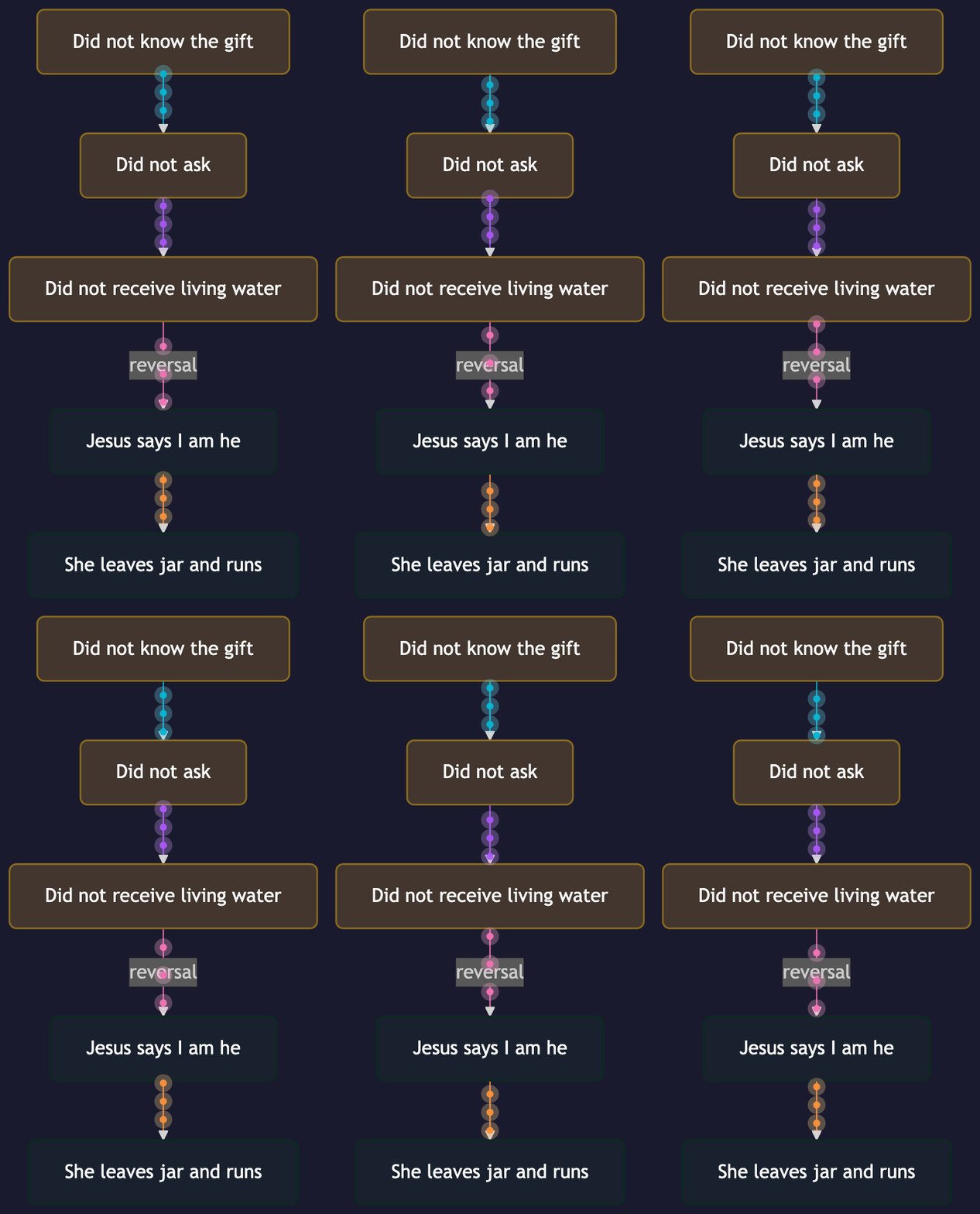
Animated chain — not knowing blocks receiving until Jesus reveals himself.
In one sentence: Not knowing → not asking → not receiving — the gift was already there.
Watch for: Jesus informs; he does not rebuke her ignorance.
One verse states the cost of not-knowing as a chain of consequences. Nothing was withheld except by ignorance.
| Step | Greek | Effect |
|---|---|---|
| “If you knew the gift of God, and who it is who says to you, give me a drink…” | ei ēdeis — contrary-to-fact condition | She did not know |
| “…you would have asked him…” | sy an ētēsas auton | Therefore she did not ask |
| “…and he would have given you living water.” | edōken an soi hydōr zōn | Therefore she did not receive |
| Resolution | 4:26 — “I who speak to you am he” (egō eimi) | The moment knowledge lands, she leaves the jar and runs (4:28–29) |
Jesus does not rebuke her. He informs her. The water had been standing in front of her for the whole conversation.
🚫 “We Know” as the Negative Pole
In one sentence: Confident “we know” without Jesus ends in judgment; honest ignorance can end in worship.
Watch for: 9:41 — “we see” → your sin remains.
This is where a simple “knowledge equals blessing” equation breaks. In John 9 the people who say oidamen, “we know”, are the ones who end up blind.
| Ref | Speaker | Claim | Pole |
|---|---|---|---|
| 9:24 | Pharisees | “We know this man is a sinner” | Negative |
| 9:29 | Pharisees | “We know God spoke to Moses; as for this fellow, we do not know where he is from” | Negative |
| 9:25 | The healed man | “Whether he is a sinner I do not know. One thing I know: I was blind, now I see” | Positive |
| 9:31 | The healed man | “We know God does not hear sinners…” — their own formula turned back on them | Positive, ironic |
| 9:30 | The healed man | “Here is the marvel: you do not know where he is from, and he opened my eyes” | Positive |
| 9:41 | Jesus | “Now you say ‘we see’ — therefore your sin remains” | Verdict |
| 7:27 | The crowd | “We know where this man is from” — used as an argument that he cannot be the Christ | Negative |
The beggar’s honest “I do not know” ends in worship (9:38). The experts’ confident “we know” ends in expulsion and menei — “your sin remains” (9:41). So the accurate formulation is not knowledge → life but knowledge of Jesus → life; knowledge held instead of Jesus → judgment.
👑 Jesus as the One Who Knows
In one sentence: Jesus knows hearts — humans receive knowledge; they do not attain gnōsis.
Watch for: 2:24–25 — both know-verbs in one sentence.
One whole branch of the knowledge vocabulary is not about human response at all — it is a Christological claim, and it is why John can drop the noun gnōsis: nobody in this Gospel attains knowledge, they receive it.
| Ref | What Jesus knows | Narrative effect |
|---|---|---|
| 1:48 | “Before Philip called you, I saw you under the fig tree” | Nathanael’s confession follows instantly (1:49) |
| 2:24–25 | He knew all men; needed no testimony about man; knew what was in man | ginōskō and oida stacked in one sentence |
| 4:29 | “He told me everything I ever did” | Becomes the Samaritan woman’s evangelistic argument |
| 6:64 | He knew from the beginning who would not believe, and who would betray him | 6:66 is not a surprise |
| 13:1 | Knowing that his hour had come | Frames the entire Book of Glory |
| 18:4 | Knowing all that was coming upon him, he went out to meet them | The arrest happens on his initiative |
| 21:17 | Peter: “Lord, you know all things” | The last appeal in the Gospel is to Jesus’ knowledge |
👂 ἀκούω — Hearing, the Door into Knowing

Animated hear → know → follow versus cannot hear.
In one sentence: Hearing is the door — hear → know → follow, or cannot hear and remain unknown.
Watch for: 8:43 vs 10:27 — the whole machine in two verses.
Underneath both belief and knowledge sits a third verb. In John you hear, then you know, then you follow — and the sharpest condemnation in the Gospel is an inability to hear.
| Ref | Statement | Pole |
|---|---|---|
| 5:24 | He who hears my word and believes → has life, does not come into krisis | Positive — hearing precedes believing |
| 5:25 | The dead will hear the voice of the Son of God, and those who hear will live | Positive |
| 10:3 | The sheep hear his voice; he calls his own by name and leads them out | Positive |
| 10:27 | My sheep hear my voice, and I know them, and they follow me | hear → know → follow, in one verse |
| 8:43 | Why do you not understand my speech? Because you cannot hear my word | Negative — ou dynasthe akouein |
| 8:47 | He who is of God hears God’s words; you do not hear, because you are not of God | Negative |
| 18:37 | “Everyone who is of the truth hears my voice” | Spoken to Pilate — the last invitation in the trial |
Set 10:27 against 8:43 and the whole machine is visible in two verses: the sheep hear and are known; the others cannot hear and remain unknown.
👥 Characters Sorted by Response
✅ Positive — worship, confession, costly follow
Nathanael, Samaritan woman & townspeople, royal official, man born blind, Martha, Mary of Bethany, Thomas (20:28), and others who believe openly.
↔️ Moves across the line — not fixed on day one
Nicodemus (night → spices), Joseph of Arimathea (secret disciple), Thomas (doubt → confession), Peter (denial → restoration).
⚠️ Belief without confession or collapse
Rulers of 12:42–43 (believed, would not confess); “believing” Jews of 8:31 who end with stones; crowd of 6:66 who walked away.
❌ Negative — refusal, irony, evasion
Judas (into the night), Caiaphas (true prophecy, murderous intent), Pilate (“What is truth?”).
Tap a group for a quick orientation — full table below has every name and verse.
In one sentence: John stages people — Nicodemus, secret rulers, collapsing believers — not flat types.
Watch for: Movement across the line; denial is not always final (Peter, Thomas).
John does not moralise. He stages people, and lets the response do the work.
| Character | Ref | Response | Pole |
|---|---|---|---|
| John the Baptist | 1:29; 3:30 | “Behold the Lamb of God”; “he must increase” | Positive |
| Nathanael | 1:49 | “Rabbi, you are the Son of God, the King of Israel” | Positive |
| Samaritan woman | 4:29, 39 | “Come see a man…” — many Samaritans believed because of her word | Positive |
| Samaritan townspeople | 4:42 | “We have heard for ourselves — this is truly the Saviour of the world” | Positive, matured |
| Royal official | 4:50, 53 | Believed the word before the evidence, then he and his house believed | Positive, two stages |
| Man born blind | 9:38 | “Lord, I believe” — worshipped | Positive, climactic |
| Martha | 11:27 | “I have believed that you are the Christ, the Son of God” | Positive |
| Mary of Bethany | 12:3 | Anoints him for burial | Positive, costly |
| Thomas | 20:28 | “My Lord and my God” | Positive — the Gospel’s highest confession |
| Nicodemus | 3:2; 7:50; 19:39 | Night → cautious defence → 75 pounds of spices | Moves across the line |
| Joseph of Arimathea | 19:38 | A disciple, but secretly, for fear of the Jews | Positive but hidden |
| The rulers of 12:42 | 12:42–43 | Believed, would not confess | Belief without confession |
| The crowd of 6:66 | 6:66 | Many of his disciples went back and walked with him no more | Reversal |
| The “believing” Jews of 8:31 | 8:31–44, 59 | Believed him — then argue, then pick up stones | Belief that collapses |
| Judas | 6:70–71; 13:30 | One of the Twelve; goes out into the night | Negative from inside |
| Caiaphas | 11:49–52 | Prophesies truly while intending murder | Negative, ironic |
| Pilate | 18:38; 19:22 | “What is truth?” — judges, and is judged | Negative, evasive |
⚖️ John as a Lawsuit: Structure Behind the Vocabulary
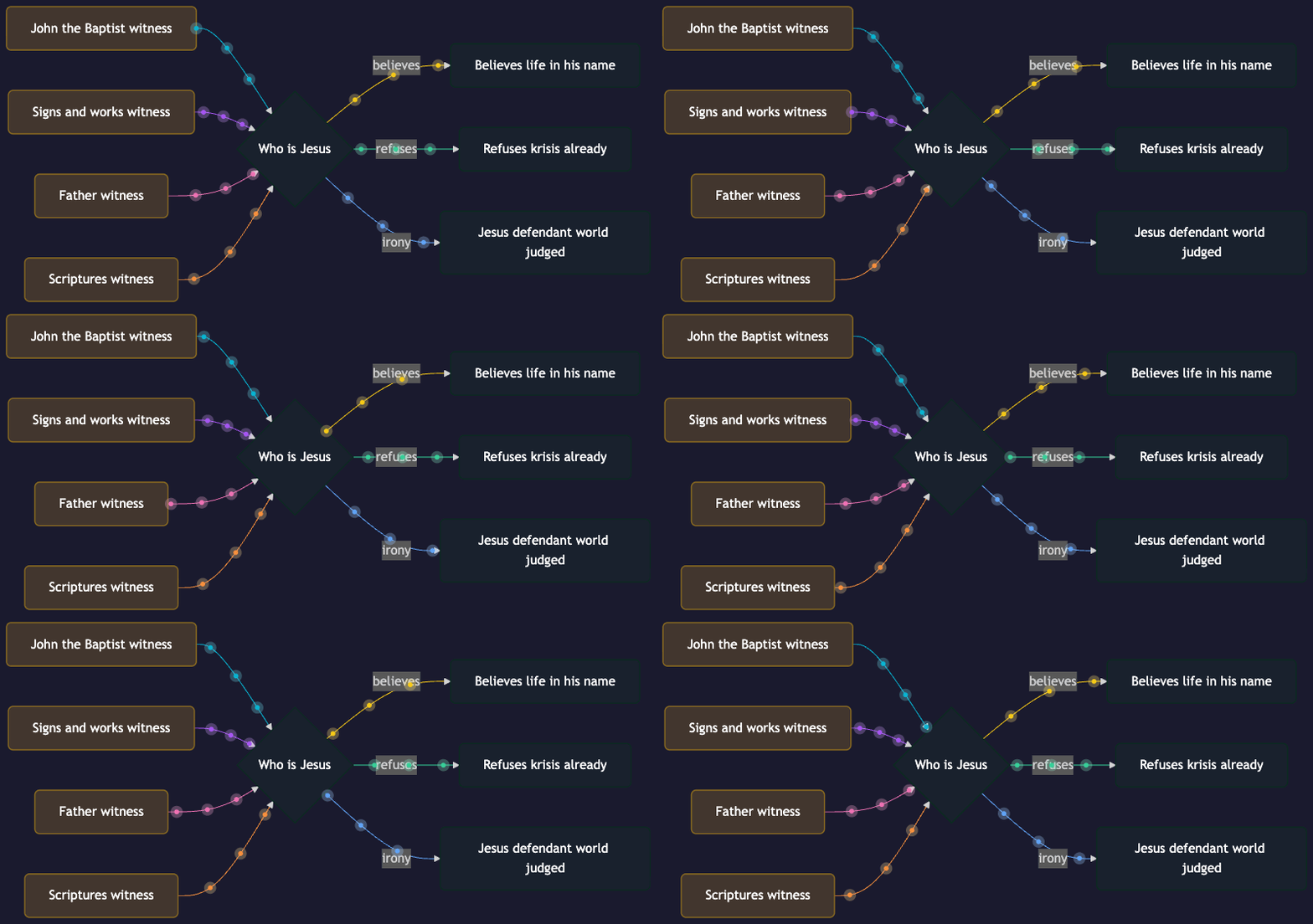
Animated lawsuit — witnesses, verdict, and trial irony.
In one sentence: Witnesses testify, a verdict falls, and Jesus stands as defendant while the world is judged.
Watch for: The Gospel itself is witness (20:31).
Andrew Lincoln’s Truth on Trial argues that the witness words (martyreō, martyria) and the judgment words (krinō, krisis) carry legal weight and cohere into a trial motif that drives the whole plot, read against the lawsuits between God and the nations in Isaiah.
| Stage | Element | Reference | Leads to |
|---|---|---|---|
| Witnesses testify | John the Baptist | 1:7, 1:15, 5:33 | The case: who is Jesus? |
| The works / signs | 5:36, 10:25 | ||
| The Father | 5:37, 8:18 | ||
| The Scriptures | 5:39 | ||
| The Paraclete (Helper) + disciples | 15:26–27 | ||
| Verdict | Believes | 20:31 | Life in his name |
| Verdict | Refuses | 3:18 | Krisis — already judged |
| Irony | Jesus stands as defendant | 18:28–19:16 | While the world is judged at the cross (12:31) |
| Witness | Reference | Testimony given |
|---|---|---|
| John the Baptist | 1:7, 15, 34; 5:33 | “This is the Son of God” |
| The works | 5:36; 10:25; 14:11 | “The works I do bear witness of me” |
| The Father | 5:37; 8:18 | Direct testimony |
| The Scriptures | 5:39, 46 | “Moses wrote of me” |
| The Samaritan woman | 4:39 | Many believed because of her word |
| The crowd at Lazarus’ tomb | 12:17 | Bore witness that he called Lazarus out |
| The Paraclete | 15:26 | The Spirit of truth will bear witness |
| The disciples | 15:27 | “You also bear witness” |
| The eyewitness at the cross | 19:35 | “He who has seen has borne witness” |
| The Gospel itself | 20:31; 21:24 | Written that you may believe |
%%{init: {"theme": "base", "themeVariables": {"background": "transparent", "lineColor": "#444444"}}}%%
flowchart TD
    P["Prosecution — world loved darkness"] --> W["Witnesses — John, signs, Father, Scripture"]
    W --> D["Defendant speaks — Son's I AM claims"]
    D --> V{"Verdict — krisis / krima"}
    V -->|Believe| L["Life — already crossed over"]
    V -->|Refuse| J["Judgment — already condemned"]
    V -->|Mixed crowd| S["Schisma — people tear"]
    class W,D neutral
    class L outcome
    class J,S split

classDef truth fill:#bbf7d0,stroke:#16a34a,color:#14532d
classDef outcome fill:#fde68a,stroke:#ca8a04,color:#92400e
classDef split fill:#fecaca,stroke:#991b1b,color:#991b1b
classDef neutral fill:#e0e7ff,stroke:#34558b,color:#1e3a8a
John’s trial motif: witnesses stack up, Jesus speaks, and the verdict lands in the present tense — believe, refuse, or split.
🎓 What the Scholars Call the Pattern
In one sentence: Different labels (dualism, lawsuit, realized eschatology) answer different questions — none replaces the text.
Watch for: Qumran vs John — conflict is about Jesus, not two spirits.
Four labels are worth knowing, because they answer slightly different questions.
| Label | Associated with | Claim | Weakness |
|---|---|---|---|
| Johannine dualism (moral/ethical) | Standard usage; Ladd, Stein | Light/darkness, life/death, above/below run through the Gospel as moral categories | Can flatten characters into two boxes |
| Dualism of decision (Entscheidungsdualismus) | Bultmann | The poles are produced by the decision about Jesus, not by pre-existing natures | Recent work (e.g. Mader, ZNW 2022) argues Nicodemus and the Samaritan woman resist simple bipolarity |
| Lawsuit / trial motif | Lincoln, Truth on Trial; earlier Harvey | Witness + judgment vocabulary form a cosmic trial that drives the plot | Not every pericope is forensic |
| Realized eschatology | C. H. Dodd | Judgment and life are present realities, not only future | John retains future judgment (5:28–29; 12:48) |
| Vertical + horizontal salvation | Raymond Brown | Vertical = the uniqueness of the descent; horizontal = its place in salvation history | A synthesis rather than a thesis |
On origins there is a live dispute. Bultmann read the dualism against a pre-Christian gnostic background; the Qumran discoveries shifted the consensus toward a Palestinian Jewish setting, since the scrolls show a monotheistic, ethical, eschatological dualism much closer to John’s. A key difference remains: at Qumran the conflict is between two created spirits, in John it is between the world and the incarnate Jesus.
⚠️ Where the Clean Split Gets Complicated
In one sentence: The poles are real, but characters travel — the Gospel is written so you can move.
Watch for: Same verb pisteuō for shallow and genuine faith (2:23–25).
A responsible study has to name the passages that resist a tidy two-column reading. John uses the same verb pisteuō for belief that lasts and belief that does not.
| Passage | What happens | Why it complicates the split |
|---|---|---|
| 2:23–25 | Many believed in his name seeing the signs — but Jesus “did not entrust himself to them” | Same verb both directions: they believed him, he did not believe them |
| 4:48 | “Unless you see signs and wonders you will not believe” | Sign-driven belief is treated as second-rate, not disqualifying |
| 6:66 | Many disciples turned back | Insiders can cross to the negative pole |
| 8:31–59 | Addressed to “the Jews who had believed him” — ends with stones | The stated believers become the stone-throwers |
| 12:42–43 | Rulers believed but would not confess | Belief without confession — a third category |
| 19:38–39 | Joseph “secretly, for fear”; Nicodemus brings burial spices | Secret disciples surface at the cross, not at the miracle |
| 20:24–29 | Thomas demands evidence, then gives the highest confession | Doubt is a route to the positive pole, not a pole of its own |
| 21:15–19 | Peter, who denied three times, is restored three times | The negative response is not necessarily final |
So the honest formulation is: John’s poles are real and sharp, but his characters travel between them. The Gospel is written precisely so a reader can move (20:31).
📋 The Verse-by-Verse Study Grid
In one sentence: Every row is response → consequence — use filters below to study one pole at a time.
Watch for: ± rows — schisma and mixed outcomes.
Every verse below states a response to Jesus and its consequence. Read the middle column and the pattern preaches itself.
| Ref | Response to Jesus | Stated consequence | Pole |
|---|---|---|---|
| 1:11 | His own did not receive him | — | − |
| 1:12 | As many as received him, believing in his name | Authority to become children of God | + |
| 2:11 | Disciples saw the glory | They believed in him | + |
| 2:24 | Many believed the signs | Jesus did not entrust himself to them | ± |
| 3:16 | Whoever believes | Shall not perish but have eternal life | + |
| 3:18a | The one believing | Is not judged | + |
| 3:18b | The one not believing | Has been judged already | − |
| 3:19 | Loved the darkness rather than the light | This is the krisis | − |
| 3:20 | Hates the light, does not come | Lest his works be exposed | − |
| 3:21 | Does the truth, comes to the light | Works shown to be wrought in God | + |
| 3:36a | Believes in the Son | Has eternal life | + |
| 3:36b | Refuses the Son | Shall not see life; the wrath remains | − |
| 4:10 | “If you knew the gift of God… you would have asked” | Not knowing → not asking → not receiving | − |
| 4:39 | Samaritans believed her word | They came to him | + |
| 4:42 | Heard for themselves | “The Saviour of the world” | + |
| 4:53 | The official believed the word | He and his whole house believed | + |
| 5:16, 18 | The Sabbath healing rejected | They sought to kill him | − |
| 5:24 | Hears and believes | Has life; does not come into krisis; has crossed from death to life | + |
| 5:29 | Did good vs practised evil | Resurrection of life vs resurrection of krisis | ± |
| 5:40 | “You are not willing to come to me” | That you may have life | − |
| 6:29 | “This is the work of God: that you believe” | — | + |
| 6:35 | Comes to him / believes in him | Never hunger, never thirst | + |
| 6:66 | Many disciples went back | Walked with him no more | − |
| 6:68–69 | Peter: “to whom shall we go?” | “We have believed and come to know” | + |
| 7:43 | Division over his word | schisma in the crowd | ± |
| 8:12 | Follows him | Will not walk in darkness, will have the light of life | + |
| 8:24 | Do not believe that egō eimi | “You will die in your sins” | − |
| 8:32 | Knows the truth | The truth will set you free | + |
| 8:31–32 | Abides in his word | Truly disciples; the truth will free you | + |
| 8:59 | “Before Abraham was, I am” | They picked up stones | − |
| 9:16 | The Sabbath sign | schisma among the Pharisees | ± |
| 9:24, 29 | “We know this man is a sinner” | Confident knowledge that ends in blindness (9:41) | − |
| 9:25 | “One thing I know: I was blind, now I see” | Honest ignorance that ends in worship (9:38) | + |
| 9:38 | “Lord, I believe” | He worshipped him | + |
| 9:39 | Jesus came for krima | Non-seeing see; seeing become blind | ± |
| 9:41 | “We see” | “Your sin remains” | − |
| 10:19 | The shepherd discourse | schisma again | ± |
| 10:14–15 | “I know my own and my own know me” | Mutual knowledge, modelled on Father and Son | + |
| 10:27–28 | My sheep hear my voice and follow | I give them eternal life; no one snatches them | + |
| 11:25–27 | Martha believes | “Though he die, yet shall he live” | + |
| 11:45 | Many saw and believed | — | + |
| 11:46, 53 | Some informed the Pharisees | They plotted to kill him | − |
| 12:31 | The lifting up | Now is the krisis of this world | ± |
| 12:37 | So many signs seen | They were not believing in him | − |
| 12:42–43 | Rulers believed, would not confess | Loved the glory of men more than of God | − |
| 12:46 | Believes in him | Does not remain in darkness | + |
| 12:48 | Rejects and does not receive his words | The word will judge on the last day | − |
| 13:17 | Knows these things and does them | “Blessed are you” | + |
| 14:7 | Knows Jesus | “You know the Father also, and have seen him” | + |
| 15:5–6 | Abides vs does not abide | Much fruit vs cast out, withered, burned | ± |
| 15:15 | Called friends, not servants | “All I heard from my Father I made known to you” | + |
| 16:3 | Have not known the Father nor me | The stated cause of persecution | − |
| 16:8–11 | The Paraclete comes | Convicts the world of sin, righteousness and krisis | ± |
| 18:6 | Egō eimi in the garden | They drew back and fell to the ground | − |
| 20:28 | Thomas: “My Lord and my God” | — | + |
| 20:31 | These are written that you may believe | That believing you may have life in his name | + |
📈 Summary
In one sentence: The numbers lock the pattern — 98 verbs, 0 nouns, 3 schismata, 7 signs.
Watch for: Flip the cards below for plain-English meanings.
| Item | Figure |
|---|---|
| Occurrences of pisteuō in John | 98 (more than Matthew, Mark and Luke combined) |
| Occurrences of the noun pistis in John | 0 |
| Occurrences of ginōskō + oida in John | roughly 140 combined |
| Occurrences of the noun gnōsis in John | 0 |
| Occurrences of makarios (“blessed”) in John | 2 — 13:17 and 20:29 |
| Occurrences of schisma in John (of people) | 3 — 7:43, 9:16, 10:19 |
| Occurrences of schisma of people in the Synoptics | 0 |
| Occurrences of krima in John | 1 — 9:39 |
| Absolute egō eimi sayings | 7 — 8:24, 8:28, 8:58, 13:19, 18:5, 18:6, 18:8 |
| Signs before the cross | 7 — every one produces a divided response |
| Tense of “has been judged” in 3:18 | Perfect passive — already settled |
| Tense of “has crossed over” in 5:24 | Perfect active — already settled |
| Stated purpose of the Gospel | 20:31 — that you may believe and have life in his name |
The whole Gospel can be stated in one sentence of Greek grammar: krisis is neutral, and the response supplies the sign. Jesus does not create the two groups; he reveals them, and the same light that gives sight to the man born blind leaves the men who insisted they could see exactly where they were.
John 20:31 (NKJV)
but these are written that you may believe that Jesus is the Christ, the Son of God, and that believing you may have life in His name.
🎯 The Takeaway
In one sentence: Krisis is neutral; the response supplies the sign — and 20:31 says why the book was written.
Watch for: All six bullets are worth memorising as a study outline.
- Krisis is neutral — the Greek word means separation before it means condemnation; your response to Jesus supplies the sign.
- The verdict is present tense — perfect verbs in 3:18 and 5:24 show judgment and crossing-over are already settled states, not only future courtroom scenes.
- Belief is a verb, not a possession — John uses pisteuō 98 times and never the noun pistis; faith is something you do toward a person.
- Every sign divides — all seven pre-cross miracles produce a split response; the crowd tears (schisma) three times when word, work, or claim meets unbelief.
- Jesus reveals what hearts choose — though John also speaks of hardening where refusal becomes fixed (12:39–40); the light exposes rather than invents what was already there.
- The Gospel is written to move you — 20:31 states the purpose: that you may believe and have life in his name.
Krisis is neutral, and the response supplies the sign. The same light that gives sight to the man born blind leaves the men who insisted they could see exactly where they were.
📖 Scripture-based study on krisis in John’s Gospel — Greek references follow the standard critical text; Strong’s numbers given for lookup in any interlinear.