Bible Study · Malachi & every tithe verse
Stop Robbing God? What Malachi 3 Really Says About Tithes
Malachi’s “robbing God” oracle, every tithe passage in Scripture, and a clear line between tithes, offerings, and who receives each.
Jump to a section — tap any link:
Reading guide: Gold = key phrases · bold = terms · italic = Hebrew/Greek · refs carry [original words] · tap ▸ to expand.
📋 Overview
The word “tithe” (Hebrew ma’aser, “a tenth”) appears across roughly forty passages spanning the Torah, the historical books, the prophets, and the New Testament. Malachi 3:6–12 [Hebrew: ma’aser, terumah] is the most quoted of these — the only place in the Bible where God explicitly invites people to “test” him — but it is the capstone of a practice with an eight-hundred-year textual history, not its origin.
Verses on tithes
~40
Core passages
19
Distinct tithes in the Law
3
Verse inviting God to be “tested”
1
%%{init: {"theme": "base", "themeVariables": {"background": "transparent", "lineColor": "#444444"}}}%%
flowchart LR
    Promise["Promise era\nGen 14 · 28"] --> Law["Law instituted\nLev · Num · Deut"]
    Law --> History["Practice & neglect\n2 Chr · Neh"]
    History --> Prophets["Prophets\nAmos · Malachi 3"]
    Prophets --> NT["NT references\nMatt · Luke · Heb 7"]

    class Promise,NT promise
    class Law law
    class History,Prophets neutral

classDef promise fill:#bbf7d0,stroke:#16a34a,color:#14532d
classDef law fill:#fde68a,stroke:#ca8a04,color:#92400e
classDef neutral fill:#dcfce7,stroke:#16a34a,color:#14532d
Eight hundred years of tithe language in Scripture — from Abram’s tenth to Malachi’s storehouse oracle and Hebrews’ priesthood argument.
The Law describes three parallel tithe streams — Levite income, festival celebration, and third-year welfare — not a single tenth that covers everything.
What this report covers
A close reading of Malachi’s tithing oracle in its historical setting (post-exilic Jerusalem, c. 460–430 BC), including the priesthood indictment of Malachi 2; a full inventory of every tithe-related verse from Genesis to Hebrews, organized and searchable; a clear distinction between tithe and offering; and an honest look at who the tithe was for, then and now.
The short version
Malachi accuses the returned exiles of shortchanging the temple — bringing blemished offerings and withholding the tithes that supported the Levites — and frames it as “robbing God.” He promises that full, faithful giving into the “storehouse” will be met with agricultural blessing. Later texts (Nehemiah 13) show this exact problem being fixed in real time.
Where the verses come from
Count of core passages profiled in the “All Tithe Verses” section, by section of the canon.
How to use this report
- Use the section list at the top to jump between sections — each one covers a different angle of the topic.
- “All Tithe Verses” lists every passage — use browser search for a keyword (e.g. “Levite,” “storehouse,” “Abraham”).
- Collapsible sections (tap to expand) keep long passages digestible; tables give side-by-side comparisons.
- Text highlighted like this marks the phrase a section is built around.
📖 Malachi In Depth: Will a Man Rob God?
Key points
- Malachi writes c. 460–430 BC, into a post-exilic Jerusalem that has grown spiritually complacent — the temple stands, but is under-resourced.
- Chapter 2 first indicts the priests as failed teachers — “the priest’s lips should keep knowledge” (2:7) — before chapter 3 turns to withheld tithes.
- God accuses the people of “robbing God” by withholding tithes and offerings (3:8–9) — a rare, deliberately shocking Hebrew verb.
- He commands them to bring the full tithe into the “storehouse” (3:10) — the temple’s collection chambers that fed the Levites and priests.
- Malachi 3:10 [Hebrew: ma’aser] is the only verse in the Bible where God invites people to “test” him — as proof of his own faithfulness, not a general rule.
- Nehemiah 13 [Hebrew: ma’aser], from the same era, shows this exact problem — and its fix — playing out in real administrative life.
Historical setting
Last OT book, likely 460–430 BC — post-exile, second temple rebuilt (516 BC), same era as Ezra–Nehemiah. “Malachi” means my messenger; tradition treats it as a proper name.
The initial excitement of the return from exile had faded. The temple stood, but it was under-resourced and under-attended:
- Priests offered blind, lame, and diseased animals in sacrifice (Malachi 1:6–14) — a rebuke that “you would not dare offer this to your governor.”
- The priests had corrupted the covenant of Levi and stopped teaching the law faithfully (2:1–9) — covered in its own section below.
- Marriages within the community were being dissolved through easy divorce (2:14–16).
- Intermarriage with idolatrous neighbors was common.
- The people had grown cynical, asking “Where is the God of justice?” (2:17).
It is against this backdrop of spiritual fatigue that chapter 3 opens.
| Date | Event |
|---|---|
| c. 538 BC | Cyrus’s decree allows Jewish exiles to return from Babylon to Judah. |
| c. 516 BC | The second temple is completed under Zerubbabel and Joshua the high priest. |
| c. 460–430 BC | Malachi prophesies into a community that has grown complacent — corrupt priesthood, withheld tithes, broken marriages. |
| c. 445–433 BC | Nehemiah governs Jerusalem, rebuilds the walls, and (on a return visit, Nehemiah 13 [Hebrew: ma’aser]) finds the Levites’ tithes still being neglected — the same problem Malachi names, being corrected in real time. |
The priesthood indictment: Malachi 2:1–9
Malachi 3:8–10 follows a chain already in motion: corrupt priests (2:7–9) → withheld tithes → empty storehouse and Levites fleeing (Nehemiah 13:10) → the robbing God charge.
Chapter 3’s tithing rebuke doesn’t come out of nowhere — chapter 2 sets it up directly, by turning on the priests and stating plainly what their job was always supposed to be:
“The law of truth was in his mouth, and iniquity was not found in his lips: he walked with me in peace and equity, and did turn many away from iniquity. For the priest’s lips should keep knowledge, and they should seek the law at his mouth: for he is the messenger of the LORD of hosts. But ye are departed out of the way; ye have caused many to stumble at the law; ye have corrupted the covenant of Levi, saith the LORD of hosts.”
Malachi 2:6–8 (KJV)
Priests must teach: “the priest's lips should keep knowledge” (Malachi 2:7). Malachi 2:1–9 charges they “corrupted the covenant of Levi” (2:8) and were “partial in the law” (2:9).
The tithe funded Israel's law-teachers (Numbers 18:21 [Hebrew: ma'aser]; Deuteronomy 33:10; Malachi 2:7). Withholding it in chapter 3 defunded instruction while those teachers were already failing. See Who Gets What for the Galatians 6:6 link.
The passage itself: Malachi 3:6–12
%%{init: {"theme": "base", "themeVariables": {"background": "transparent", "lineColor": "#444444"}}}%%
flowchart TD
    Ch2["Malachi 2 · priests corrupt covenant\nfail to teach the law"] --> Ch3["Malachi 3 · tithes withheld\nstorehouse empty"]
    Ch3 --> Teachers["Law-teachers unfunded\nNumbers 18 · Mal 2:7"]
    Teachers --> Rob["Will a man rob God?\nmaaser + terumah both named"]

    class Ch2,Ch3 law
    class Teachers,Rob promise

classDef law fill:#fecaca,stroke:#991b1b,color:#991b1b
classDef promise fill:#bbf7d0,stroke:#16a34a,color:#14532d
Chapter 3’s tithe charge sits inside a priesthood already failing to teach — withholding defunded instruction while teachers were partial in the law.
%%{init: {"theme": "base", "themeVariables": {"background": "transparent", "lineColor": "#444444"}}}%%
flowchart TD
    Withheld["v8-9 · Tithes withheld"] --> Storehouse["v10 · Bring full tithe into storehouse"]
    Storehouse --> Food["Food in my house"]
    Food --> Test["Put me to the test"]
    Test --> Windows["Open windows of heaven"]
    Windows --> Blessing["Blessing until no lack"]
    Blessing --> Devourer["v11 · Rebuke the devourer"]
    Devourer --> Yield["Land and vine produce"]

    class Storehouse,Food,Test,Windows,Blessing,Devourer,Yield promise
    class Withheld law

classDef promise fill:#bbf7d0,stroke:#16a34a,color:#14532d
classDef law fill:#fecaca,stroke:#991b1b,color:#991b1b
classDef gold fill:#fde68a,stroke:#ca8a04,color:#92400e
Malachi 3:10–11 — the blessing chain runs forward only after the storehouse is filled; “test me” sits inside that sequence, not as a freestanding formula.
“For I the LORD do not change; therefore you, O children of Jacob, are not consumed. Yet from the days of your fathers you have turned aside from my statutes and have not kept them. Return to me, and I will return to you, says the LORD of hosts. But you say, ‘How shall we return?’ Will man rob God? Yet you are robbing me. But you say, ‘How have we robbed you?’ In your tithes and contributions. You are cursed with a curse, for you are robbing me, the whole nation of you. Bring the full tithe into the storehouse, that there may be food in my house. And thereby put me to the test, says the LORD of hosts, if I will not open the windows of heaven for you and pour down for you a blessing until there is no more need. I will rebuke the devourer for you, so that it will not destroy the fruits of your soil, and your vine in the field shall not fail to bear, says the LORD of hosts. Then all nations will call you blessed, for you will be a land of delight, says the LORD of hosts.”
Malachi 3:6–12 [Hebrew: ma’aser, terumah] (ESV, paraphrased close to KJV wording)
Bring ye all the tithes into the storehouse, that there may be meat in mine house, and prove me now herewith, saith the LORD of hosts, if I will not open you the windows of heaven…
Malachi 3:10 (KJV, abridged)
Verse-by-verse notes
Full passage above (ESV); tap each verse for the KJV text and a one-line note — v. 8–9 expanded by default.
v. 6 — “I the LORD do not change”
“For I am the LORD, I change not; therefore ye sons of Jacob are not consumed.”
Malachi 3:6 (KJV)
God’s unchanging character is mercy — Israel survives despite generations of unfaithfulness.
v. 7 — “Return to me, and I will return to you”
“Even from the days of your fathers ye are gone away from mine ordinances, and have not kept them. Return unto me, and I will return unto you, saith the LORD of hosts. But ye said, Wherein shall we return?”
Malachi 3:7 (KJV)
A covenant call to return; Israel’s “How?” sets up the book’s charge-and-reply pattern.
v. 8–9 — “Will a man rob God?”
“Will a man rob God? Yet ye have robbed me. But ye say, Wherein have we robbed thee? In tithes and offerings. Ye are cursed with a curse: for ye have robbed me, even this whole nation.”
Malachi 3:8–9 (KJV)
Rare Hebrew qava — corporate robbery in ma’aser (tithe) and terumah (offering).
v. 10 — “Bring the full tithe into the storehouse”
“Bring ye all the tithes into the storehouse, that there may be meat in mine house, and prove me now herewith, saith the LORD of hosts, if I will not open you the windows of heaven, and pour you out a blessing, that there shall not be room enough to receive it.”
Malachi 3:10 (KJV)
Otsar storehouse feeds landless Levites — the only place God invites Israel to test him.
Word study: “meat”/”food” — is it physical or spiritual?
The Hebrew word behind “meat” (KJV) / “food” (NIV, ESV, NASB) is טֶרֶף (tereph, Strong’s H2964), from a root meaning “to tear/rend.” Across all 23 Old Testament occurrences — Genesis 49:9, Job 24:5, Psalm 111:5, Proverbs 31:15, Ezekiel 17:9, and others — it denotes torn animal prey, war plunder, or literal food/household provisions. It is never used elsewhere in the Hebrew Bible for abstract spiritual nourishment, and it is a different word entirely from lechem (“bread”), the term behind the manna narratives (Exodus 16; Deuteronomy 8:3) that later feed John 6’s “bread of life” discourse — so there is no lexical bridge between this verse and those.
Every major translation (KJV, NIV, ESV, NASB, NKJV, NLT, CSB) and classic commentary consulted (Matthew Henry, Keil & Delitzsch, the Pulpit Commentary, John Gill, Barnes’ Notes, Cambridge Bible) reads it the same way: literal grain, wine, and oil meant to physically sustain the priests and Levites — echoing Nehemiah 13:10 [Hebrew: ma’aser]–12 [Hebrew: ma’aser], where the Levites literally “fled every one to his field” for lack of that food. A search for a genuine spiritual-food reading of this specific phrase turned up essentially nothing in serious scholarship — the only “spiritual” gloss found came from a New Thought/metaphysical source outside historic orthodox commentary, reinterpreting the tithe given rather than the food received. Verdict: physical food, with high confidence — though the broader principle (God provides materially for those who materially support his work) is often applied devotionally today.
v. 11–12 — The promised blessing
“And I will rebuke the devourer for your sakes, and he shall not destroy the fruits of your ground; neither shall your vine cast her fruit before the time in the field, saith the LORD of hosts. And all nations shall call you blessed: for ye shall be a delightsome land, saith the LORD of hosts.”
Malachi 3:11–12 (KJV)
Agricultural covenant blessing — Deuteronomy 28 language tied to the land.
Cross-reference: Nehemiah 13 [Hebrew: ma’aser]
Same crisis Malachi names: Levites' portions withheld; they fled to their fields (Nehemiah 13:10 [Hebrew: ma'aser]). Nehemiah restores tithes to storehouses and appoints treasurers (13:13) — prophet's rebuke and governor's fix, same era.
⚖️ Tithe vs Offering: Two Different Movements of Faith
Two words where English often says only “giving”: the tithe looks backward in gratitude for increase already in hand; the offering looks forward in faith, like Abel — “By faith Abel offered” (Hebrews 11:4 [Greek: prospherō; Hebrew: minchah]).
Tithe responds to increase already received; offering is sown in faith toward what is not yet in hand.
Key points
- Tithe = fixed 10%, backward-looking — a response to increase already in hand (Leviticus 27:30).
- Offering = variable, voluntary, forward-looking — a gift given in faith, modeled on Abel (Hebrews 11:4; Genesis 4:3–5 [Hebrew: minchah]).
- Both appear together in Malachi 3:8 [Hebrew: ma’aser, terumah] as two distinct things being withheld.
- The New Testament’s sowing/reaping language (2 Corinthians 9:6; Galatians 6:7) is where the “offering as seed” teaching comes from.
- Open each collapsible subsection below for Definitions, the Comparison Table, The Seed Principle, and Who Gets What.
The anchor text: Hebrews 11:4 [Greek: prospherō; Hebrew: minchah]
“By faith Abel offered unto God a more excellent sacrifice than Cain, by which he obtained witness that he was righteous, God testifying of his gifts: and by it he being dead yet speaketh.”
Hebrews 11:4 [Greek: prospherō; Hebrew: minchah] (KJV)
Both brought minchah; only Abel's was accepted. Hebrews 11:4 [Greek: prospherō; Hebrew: minchah] names faith as the difference — voluntary gift, not a required tenth. That is the offering-as-seed pattern.
The subsections below are collapsible — tap to open each one.
⚖️ Definitions: Tithe and Offering
Tithe —מַעֲשֵׂרma’aser, “a tenth”
Fixed at ten percent of harvest, flock, or income already received. Leviticus 27:30 [Hebrew: ma'aser]: produce already in hand “is the LORD's” — acknowledgment, not a forward-looking pledge.
Offering —מִנְחָהminchah,נְדָבָהnedavah,תְּרוּמָהterumah
Freewill (nedavah), tribute (minchah), or set-apart gift (terumah) — no fixed percentage. Given above what is required, often at worship or need; in the seed framework, in faith toward what is not yet seen.
Word study: is “rich” hiding inside the word “tithe”?
A connection often pointed out in teaching: Hebrew מַעֲשֵׂר (ma’aser, “tithe”) is built from עֶשֶׂר (eser, “ten”) — confirmed by Strong’s own note that the related verb “to tithe” (H6237) is “denominative from eser,” i.e. it’s literally the number ten turned into a verb/noun about tithing. Separately, the Hebrew word for “to be/become rich” is עָשַׁר (ashar, H6238). Written without vowel points — as all Hebrew was for most of its history — “ten” and “rich” share the exact same three consonants: ע-ש-ר. Strictly, Hebrew grammarians treat eser (“ten”) and ashar (“rich”) as two separate roots that happen to share consonants, distinguished only by a vowel-point dot the Masoretes added centuries later — so this is a real, defensible wordplay on the consonantal text, not solid proof of a single shared origin. Whether coincidence or design, it’s a striking one: the word for “tithe” is quite literally built on the word for “ten,” sitting one letter-shape away from the word for “riches.”
Genesis 14 [Hebrew: ma’aser] reads like a live illustration of the connection: Abram tithes to Melchizedek (v. 20), and in the very next breath refuses the king of Sodom’s wealth “lest thou shouldest say, I have made Abram rich” (v. 22–23) — see the full passage in the “All Tithe Verses” section. The narrative ties Abram’s tithe and his riches together in the same scene, with God alone left to get credit for either.
⚖️ Comparison Table
| Dimension | Tithe | Offering |
|---|---|---|
| Hebrew term | ma’aser — “the tenth” | minchah (gift/tribute), nedavah (freewill gift), terumah (contribution) |
| Amount | Fixed — 10% of increase | Variable — determined by the giver, “as he purposeth in his heart” (2 Corinthians 9:7) |
| Required or voluntary | Commanded under the Law (Leviticus 27:30) | Voluntary — a “freewill offering” by definition (Leviticus 22:18, 23) |
| Time orientation | Backward-looking — a response to increase already received | Forward-looking — sown in faith toward an increase not yet seen |
| Governing posture | Gratitude and obedience | Faith and expectation |
| Sowing/harvest language used? | Rarely — framed as ownership and tribute, not agriculture-of-faith | Yes — “he which soweth bountifully shall reap also bountifully” (2 Corinthians 9:6); “whatsoever a man soweth, that shall he also reap” (Galatians 6:7) |
| Key example | Genesis 14:20 — Abram’s tenth to Melchizedek, after victory already won | Genesis 4:4; Hebrews 11:4 [Greek: prospherō; Hebrew: minchah] — Abel’s offering, given in faith, before any harvest was guaranteed |
| Paired together in | Malachi 3:8 [Hebrew: ma’aser, terumah] — “In your tithes and offerings” (ma’aser and terumah named as two distinct things being withheld) |
⚖️ The Seed Principle
Sowing toward a harvest not yet seen
NT sowing language frames offerings: “He which soweth bountifully shall reap also bountifully” (2 Corinthians 9:6 [Greek: speirō, charis], 8) — written for Jerusalem relief, but widely applied as the offering-as-seed model, distinct from the tithe's backward “this tenth was already yours, Lord.”
%%{init: {"theme": "base", "themeVariables": {"background": "transparent", "lineColor": "#444444"}}}%%
flowchart LR
    Giver["Giver · willing heart"] --> Seed["Offering sown\n2 Cor 9:6 · Gal 6:7"]
    Seed --> Faith["Before full harvest\nProv 3:9-10 · Abel"]
    Faith --> Reap["Bountiful reaping\ngrace abounding"]

    class Giver,Faith neutral
    class Seed offering
    class Reap promise

classDef offering fill:#fecaca,stroke:#991b1b,color:#991b1b
classDef promise fill:#bbf7d0,stroke:#16a34a,color:#14532d
classDef neutral fill:#fde68a,stroke:#ca8a04,color:#92400e
Offering-as-seed: sown in faith before the full harvest is in — distinct from the tithe’s backward acknowledgment of increase already received.
Proverbs 3:9–10 is often read the same way: “Honour the LORD with thy substance, and with the firstfruits of all thine increase: So shall thy barns be filled with plenty.” Firstfruits, like Abel’s offering, are given before the full harvest is in — an act of trust that more will follow.
Keeping the fuller picture in view
OT “offering” is broader than the seed lens: Leviticus mandates burnt, grain, sin, and guilt offerings (olah, minchah, chattat, asham) — not freewill faith-gifts. Seed-faith fits nedavah and Abel best. The tithe/offering split above still holds; canon “offering” covers more.
⚖️ Who Gets What
Direct answer: the elders who labor in the word are today’s pastors — and the tithe is taught to go straight to them
1 Timothy 5:17 [Greek: timē, misthos] names the teaching elder who sows the Word. Paul links spiritual sowing to material support (1 Corinthians 9:11 [Greek: speirō, therizō]); Galatians 6:6 [Greek: koinōneō] commands sharing with “him that teacheth.” With Numbers 18:21 [Hebrew: ma'aser] and Malachi 2:7, many hold the tithe lands on the preacher directly — not the whole budget.
If the tithe goes to the minister, what pays for everything else?
Building, utilities, and poor relief fall to the offering. Exodus 25:1–2 and 35:4–29 [Hebrew: nedavah] fund the tabernacle from freewill offering, not tithe — Scripture's first house of worship was built voluntarily.
Flow chart: where the giving goes
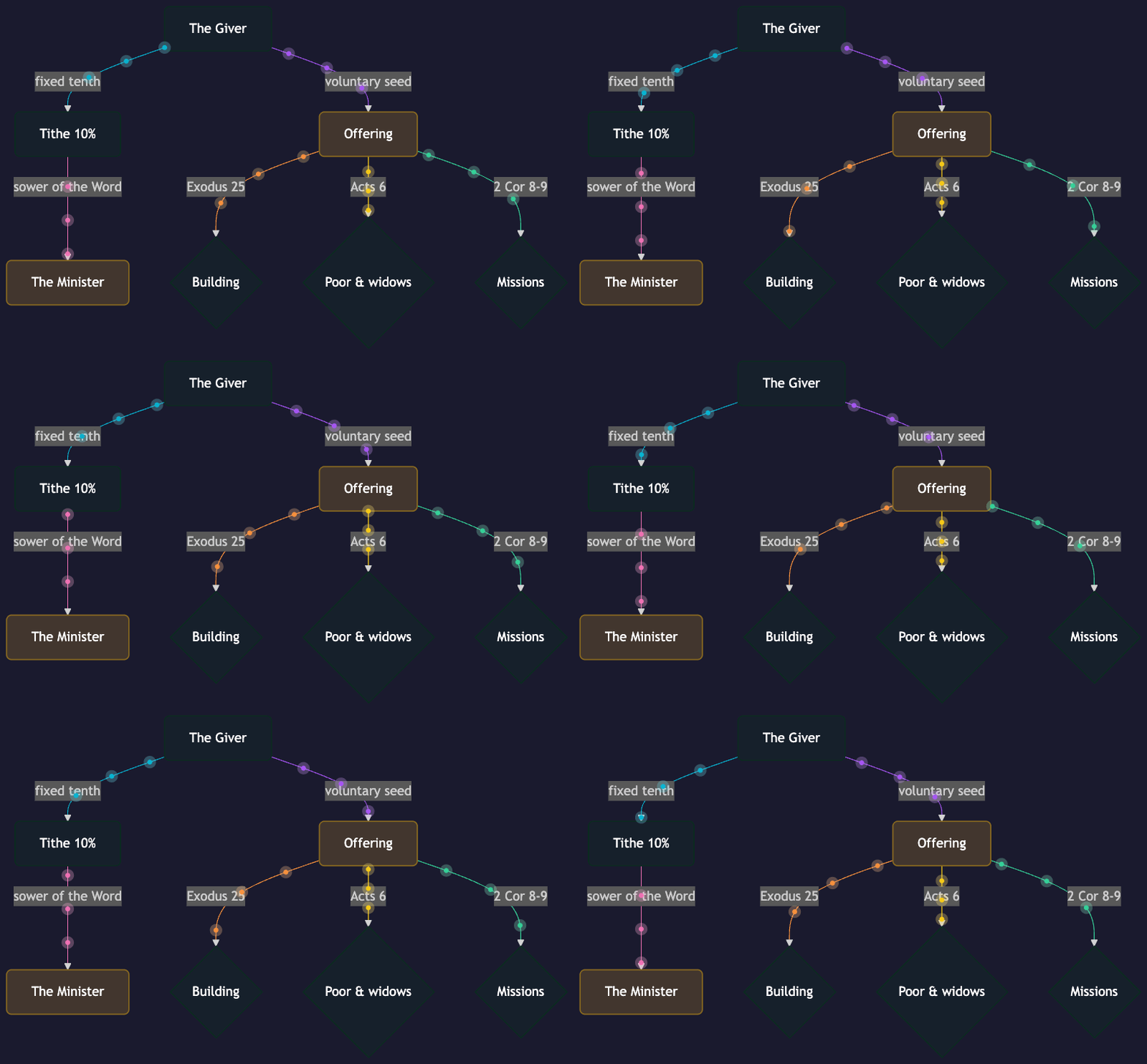
Animated giving flow — tithe (fixed) to the minister who sows the Word; offering (voluntary) to building, poor, and missions.
| Step | Detail |
|---|---|
| The Giver | brings both tithe and offering |
| Tithe — 10% | fixed · from increase already received |
| The Minister | “the sower of the Word” — Gal. 6:6; 1 Cor. 9:11; 1 Tim. 5:17–18 |
| Offering — variable | voluntary · given in faith, as a seed |
| Building & Utilities | Exodus 25:1–2 [Hebrew: terumah, nedavah]; 35:4–29 |
| Widows, Orphans, the Poor | Acts 6:1–6 [Greek: diakonia]; 1 Timothy 5:9–16 [Greek: katalegō, epakolouthéō] |
| Missions & Relief | 1 Corinthians 16:1–4 [Greek: logeia]; 2 Corinthians 8–9 [Greek: charis, koinonia, diakonia, …] |
| Expense / person | Funded by, in this framework | Key texts |
|---|---|---|
| The minister who preaches and teaches (the “sower of the Word”) | Tithe — direct, personal | Numbers 18:21 [Hebrew: ma’aser]; Malachi 2:7; Galatians 6:6 [Greek: koinōneō]; 1 Corinthians 9:11 [Greek: speirō, therizō], 13–14; 1 Timothy 5:17–18 [Greek: timē, misthos] |
| Building, rent, mortgage, utilities | Offering — voluntary, “willing heart” | Exodus 25:1–2 [Hebrew: terumah, nedavah]; 35:4–29 |
| Widows, orphans, the poor, benevolence | Offering, in the NT diaconal pattern — though the Old Covenant’s third-year tithe fed the poor directly (see note below) | Acts 6:1–6 [Greek: diakonia]; 1 Timothy 5:9–16 [Greek: katalegō, epakolouthéō]; cf. Deuteronomy 14:28–29 [Hebrew: ma’aser] |
| Missions, relief to other congregations | Offering — a “collection” (Greek logeia), not termed a tithe | 1 Corinthians 16:1–4 [Greek: logeia]; 2 Corinthians 8–9 [Greek: charis, koinonia, diakonia, …] |
A wrinkle worth naming: Deuteronomy 14 [Hebrew: ma’aser]
At first glance, Deuteronomy 14:28–29 looks like a complication: the third-year tithe explicitly fed “the Levite… and the stranger, and the fatherless, and the widow” out of the tithe itself, seeming to mix minister-support and poor-relief into one pot. Traditional reconciliation resolves this cleanly: it reads Numbers 18 and Deuteronomy 14 as two separate, parallel tithes, not one combined one. The Levites' first tithe (Numbers 18:21) was fixed and paid every year without interruption; the third-year poor tithe was an additional, separately-scheduled tithe that simply added landless Levites to its list of eligible recipients alongside the widow, orphan, and stranger (see the Deuteronomy 14:22–29 entry on the “All Tithe Verses” tab for the full year-by-year breakdown). So the Old Covenant already kept these two streams distinct — it didn't carve minister-support out of poor-relief, or vice versa. The New Testament shows the same instinct at church scale: when the Jerusalem church's care for widows outgrew personal giving, the apostles raised up a separately administered ministry (Acts 6:1–6) and a separately gathered “collection” for the poor (1 Corinthians 16; 2 Corinthians 8–9), rather than treating it as part of a minister's direct support. So: giving to the poor is consistently its own stream — the offering — running parallel to (not carved out of) support for the one who teaches, in both Testaments.
Deuteronomy 14 does not carve poor-relief out of minister-support — two scheduled tithes, plus offerings for tabernacle and collections.
⚖️ Word divide: validated at the lexicon level
Hebrew and Greek use separate vocabularies for tithe and offering — they do not overlap.
Tithe
One word family. Fixed 10%. Rooted in Numbers 18 [Hebrew: ma’aser] / Leviticus 27 [Hebrew: ma’aser].
- מַעֲשֵׂר — ma’aser (H4643) — “the tenth.” The only Hebrew word for tithe.
- δεκάτη — dekatē (G1181) — “a tenth.” Verb forms: ἀποδεκατόω / δεκατόω (G586/G1183).
- — — Occurs in NT only at Matthew 23:23 [Greek: dekatē], Luke 11:42 [Greek: dekatē], Luke 18:12 [Greek: dekatē], and Hebrews 7:2–9 [Greek: dekatē]. Never in a church-giving instruction passage.
Offering
A whole family of words. Variable amount. Occasion- and purpose-driven.
- מִנְחָה — minchah — gift, tribute, grain offering
- נְדָבָה — nedavah — freewill offering
- תְּרוּמָה — terumah — contribution, that which is set apart
- χάρις / κοινωνία — charis / koinōnia — grace-gift / fellowship-contribution
- λογεία / διακονία — logeia / diakonia — collection / service-distribution
- εὐλογία / λειτουργία — eulogia / leitourgia — bountiful gift / public ministry
Malachi 3:8 already treats them as two things
Hebrew: הַמַּעֲשֵׂר וְהַתְּרוּמָה — “the tithe (ma’aser) and the offering (terumah),” named side by side as two distinct items being withheld. This is the same verse the original report built its whole tithe/offering distinction on — and the underlying Hebrew backs it up directly.
⚖️ NT trajectory: which category is institutional giving?
All four use offering-family vocabulary; none use dekatē (tithe).
| Passage | Greek word | Meaning | Is it “tithe” (dekatē)? |
|---|---|---|---|
| Acts 4:32–35 [Greek: koina, diadidōmi] | κοινά / διαδίδωμι koina / diadidōmi | “common” / “was distributed” | No |
| Acts 6:1–6 [Greek: diakonia] | διακονία diakonia | “service, daily distribution” | No |
| 1 Corinthians 16:1–4 [Greek: logeia] | λογεία logeia | “collection” | No |
| 2 Corinthians 8–9 [Greek: charis, koinonia, diakonia, …] | χάρις, κοινωνία, διακονία, εὐλογία, λειτουργία | “grace-gift,” “fellowship,” “service,” “bounty,” “ministry” | No |
δεκάτη (tithe) does not occur in any of these four passages — confirmed verse by verse. It only appears in the NT critiquing Pharisee practice (Matt 23:23; Luke 11:42 [Greek: dekatē], 18:12) or in Hebrews 7 [Greek: dekatē]’s Abraham/Melchizedek argument.
So — is this inline with offering?
Every pooled NT gift (Jerusalem fund, deacons, collection) uses offering/collection vocabulary — never tithe language for church giving. Matches this report's framework: offering = flexible and pooled; tithe = fixed and personal.
📜 All Tithe Verses in Scripture
Every core tithe passage in the Bible, grouped by section. Search or filter to narrow the list.
How to navigate: grouped by canon section. Each card expands to the KJV scripture text only — commentary stays in the sections above. Use Ctrl+F / ⌘F to search.
%%{init: {"theme": "base", "themeVariables": {"background": "transparent", "lineColor": "#444444"}}}%%
flowchart TB
    subgraph Torah["Law · instituted"]
        G14["Gen 14 · 28"]
        L27["Lev 27"]
        N18["Num 18"]
        D14["Deut 12-14 · 26"]
    end
    subgraph Hist["Historical · practiced"]
        C31["2 Chr 31"]
        Neh["Neh 10-13"]
    end
    subgraph Prop["Prophets"]
        Am["Amos 4"]
        M3["Malachi 3"]
    end
    subgraph NT["New Testament"]
        Syn["Matt · Luke"]
        Heb["Heb 7"]
        Paul["1 Cor 9"]
    end
    Torah --> Hist --> Prop --> NT

    class G14,L27,N18,D14,C31,Neh,Am,M3,Syn,Heb,Paul neutral

classDef neutral fill:#dcfce7,stroke:#16a34a,color:#14532d
Law (Torah) — the tithe instituted
Historical Books — the tithe practiced (and neglected)
Prophets — the tithe as a measure of the heart
New Testament — from law to voluntary generosity
👤 Who Was the Tithe For? Mortal Man vs Modern Giving
Torah tithes reach named individuals — Levite, priest, widow, orphan, stranger. Today most giving passes through institutions to charities and boards. Same pattern scaled up, or a real shift in recipient? Evidence and both readings below.
Key points
- Hebrews 7:8 [Greek: dekatē] calls tithe-receiving priests “mortal men” (Greek: “dying men”) — the biblical pattern is personal, not institutional.
- Every OT tithe passage names a specific, living recipient: Levite, priest, widow, orphan, stranger — never an abstract organization.
- Melchizedek was a real mortal man too — though Hebrews’ own argument actually casts him as the “he liveth” contrast, not another “mortal man” example.
- Scripture does contain a move toward organized, delegated giving (Acts 6; the Jerusalem collection) — so the shift isn’t unprecedented.
- Scripture shows both personal tithe recipients and early organised offering distribution — the text holds local accountability and structured relief together.
And here men that die receive tithes; but there he receiveth them, of whom it is witnessed that he liveth.
Hebrews 7:8 (KJV)
The key text: Hebrews 7:8 [Greek: dekatē]
“And here men that die receive tithes; but there he receiveth them, of whom it is witnessed that he liveth.”
Hebrews 7:8 [Greek: dekatē] (KJV)
Modern translations render the phrase even more plainly — the NIV has “mortal men collect the tenth,” the NET Bible “mortal human priests receive tithes.” The underlying Greek, ἀποθνῄσκοντες ἄνθρωποι (apothnēskontes anthrōpoi), literally means “dying men” or “men who die.”
Hebrews 7:8 [Greek: dekatē] contrasts dying Levitical priests with Melchizedek/Christ who “liveth” — mainly priesthood permanence. Still precise: biblical tithe recipients are living, mortal individuals, never abstract organisations.
The biblical pattern: tithes go to named people, not intermediary institutions
Tithes reach named people: Levite households (Numbers 18:21 [Hebrew: ma'aser]), local poor at the gate (Deuteronomy 14:28–29 [Hebrew: ma'aser]), Abram to Melchizedek (Genesis 14:20). No clearinghouse — Malachi's storehouse and Nehemiah's storerooms fed specific priests and Levites.
Torah tithes reach named individuals; modern giving often passes through institutions — the text holds both personal accountability and structured relief.
Comparison table: recipient then vs. recipient now
| Category | Scripture | Tithe or offering? | Original recipient | How it reached them | Modern equivalent | Recipient today | Shift? |
|---|---|---|---|---|---|---|---|
| Landless clergy (Levites) | Numbers 18:21 [Hebrew: ma’aser], 24 [Hebrew: ma’aser] | Tithe | Individual Levite households, by name and tribe | Ate the tithe directly as their livelihood — no land of their own | Pastor / church staff salaries | Sometimes a named individual, often folded into a general payroll line | Partial |
| Priests | Numbers 18:26–28 [Hebrew: ma’aser] | Tithe | Priestly households, via the Levites’ “tithe of the tithe” | Consumed personally by the priest’s family | Denominational leadership / clergy pension funds | Often an institutional budget line, not a person | Shifted |
| Widow, orphan, stranger | Deuteronomy 14:28–29 [Hebrew: ma’aser]; 26:12–13 | Third-year welfare tithe (Law) → Offering today | Named, local, physically present individuals “within thy gates” | Direct, face-to-face provision — the giver knew the recipient | Missions boards, denominational relief agencies, registered charities | An anonymous, often distant beneficiary served by an organization’s program | Shifted |
| Enrolled widows | 1 Timothy 5:9–10 [Greek: katalegō] | Offering | Individually vetted widows, entered on a literal list by name | Direct, personal, ongoing provision from the local church | Church benevolence fund, or referred out to a charity/agency | Often a case file rather than a personally known person | Shifted |
| Elders who labor in the word | 1 Timothy 5:17–18 [Greek: timē, misthos]; 1 Corinthians 9:13–14 [Greek: thysiastērion, hieron] | Tithe | A specific, named minister — “the labourer is worthy of his reward” | Direct personal support, likened to a priest living off the altar | Salaried clergy | Often still a named individual — one of the closer parallels | Preserved |
| Melchizedek’s tithe | Genesis 14:18–20 [Hebrew: ma’aser] | Tithe | One living priest-king, given a gift hand to hand | Direct, one-time, person-to-person gift | No close modern equivalent | — | — |
| Jerusalem collection | 1 Corinthians 16:1–4 [Greek: logeia]; 2 Corinthians 8–9 [Greek: charis, koinonia, diakonia, …] | Offering | “The saints” — the poor believers in Jerusalem, a specific known group | Gathered by multiple churches, carried by chosen delegates to that group | International relief organizations, denominational funds, NGOs | A general population served through an organization’s programs | Precedent both sides cite |
“Welfare tithe → Offering” marks a row where the original mechanism was a separate Law-era welfare tithe (Deuteronomy 14:28–29 — not Numbers 18:21), but the modern equivalent is generally funded from offerings — see the Tithe vs Offering section for the full reasoning.
Follow-up: was Melchizedek’s tithe also “to a mortal man”?
Genesis 14 [Hebrew: ma'aser]: Melchizedek is a real, present individual — tithe person-to-person. Hebrews 7:8 [Greek: dekatē] does not list him among “men that die”; silence on his death places him on the “he liveth” side (7:3, 23–24). Historical individual, typological exception in Hebrews' argument.
Then and now: side-by-side comparison
Tap each row — one table per recipient: what Scripture describes, what churches often do today, and where this article argues it should go (Who Gets What; not every tradition agrees). Badges: Tithe / Offering.
🔄 The Levite — Then vs Now · Tithe
Category: Tithe
| Where the giving lands | |
|---|---|
| Scripture | Landless Levite households — they ate the tithe as their livelihood, with no tribal land of their own (Numbers 18:21–24). |
| Often today | Often a named pastor or staff salary line inside a pooled church budget. |
| This article | Directly to the one who preaches and teaches the Word — personal support, not a pooled budget line (Galatians 6:6; 1 Timothy 5:17–18 [Greek: timē, misthos]). See Who Gets What. |
Key texts: Numbers 18:21 [Hebrew: ma’aser]
🔄 Widow, orphan, stranger — Then vs Now · Welfare tithe → Offering
Category: Third-year welfare tithe (Law) → Offering today
| Where the giving lands | |
|---|---|
| Scripture | Third-year tithe stored locally — stranger, orphan, and widow “within thy gates” (landless Levites also eligible). Separate from the annual Levite tithe (Numbers 18:21). |
| Often today | Usually anonymous, distant beneficiaries served through a charity or mission agency. |
| This article | Known local poor from the offering (Acts 6; 1 Timothy 5:9–16 [Greek: katalegō, epakolouthéō]) — a separate third-year welfare tithe under the Law (Deuteronomy 14:28–29), not the annual Levite tithe (Numbers 18:21). |
Law: separate third-year welfare tithe — stored locally for the stranger, orphan, and widow (landless Levites also eligible); not the annual Levite tithe (Numbers 18:21). Today: poor relief from the offering.
Key texts: Deuteronomy 14:28–29 [Hebrew: ma’aser]
🔄 The storehouse — Then vs Now · Tithe
Category: Tithe
| Where the giving lands | |
|---|---|
| Scripture | Not a final destination — a temple depot (otsar) where tithes of grain, wine, and oil were stored, then distributed to Levites, temple singers, and priests who had no land inheritance (Numbers 18:21–32; Nehemiah 10:37–39 [Hebrew: ma’aser]; 13:10–13). |
| Often today | A general church bank account, then re-granted to salaries, building, missions, and external charities — the money rarely lands on one named Levite-equivalent household. |
| This article | The tithe to the one who preaches the Word of God — not absorbed into a general fund that pays building and missions first (Malachi 2:7; Galatians 6:6 [Greek: koinōneō]). |
Key texts: Malachi 3:10 [Hebrew: ma’aser]; Nehemiah 10:38 [Hebrew: ma’aser]
🔄 Enrolled widows — Then vs Now · Offering
Category: Offering
| Where the giving lands | |
|---|---|
| Scripture | Individually vetted widows on the church’s list — supported directly by the local congregation (1 Timothy 5:9–10). |
| Often today | A benevolence request, case file, or referral out to a third-party relief organisation. |
| This article | Enrolled, locally known widows from the offering and diaconal care (1 Timothy 5:9–16; Acts 6:1–6 [Greek: diakonia]). |
Key texts: 1 Timothy 5:9–10 [Greek: katalegō]
🔄 Mortal priests — Then vs Now · Tithe
Category: Tithe
| Where the giving lands | |
|---|---|
| Scripture | Priestly households — receiving the Levites’ “tithe of the tithe” to eat at home (Numbers 18:26–28). |
| Often today | Often an institutional budget line (denominational fund, pension pool) rather than a named priest’s table. |
| This article | The one who preaches and teaches the Word — tithe as direct personal support, not an anonymous institution (Galatians 6:6). |
Hebrews 7:8 [Greek: dekatē] contrasts “men that die” who received tithes with one who “liveth” — chiefly a priesthood argument; tithe recipients in Scripture are still living individuals, not abstract organisations.
Key texts: Hebrews 7:8 [Greek: dekatē]
🔄 The Jerusalem saints — Then vs Now · Offering
Category: Offering
| Where the giving lands | |
|---|---|
| Scripture | Poor believers in Jerusalem — a specific, known group, aided by pooled gifts carried by appointed delegates (1 Corinthians 16:1–4; 2 Corinthians 8–9 [Greek: charis, koinonia, diakonia, …]). |
| Often today | International relief funds, NGOs, or denominational programmes serving a general population. |
| This article | Relief for a known group via offering / collection language — not tithe (1 Corinthians 16:1–4; 2 Corinthians 8–9 [Greek: charis, koinonia, diakonia, …]). |
Key texts: 1 Corinthians 16:1–4 [Greek: logeia]
Tithes, offerings, and organised giving in the New Testament
Acts 4:34–35 [Greek: koina, diadidōmi], Acts 6:1–6 [Greek: diakonia], 1 Corinthians 16:1–4 [Greek: logeia], and 2 Corinthians 8–9 [Greek: charis, koinonia, diakonia, …] describe the church pooling and distributing gifts — but each passage uses offering vocabulary, not tithes (dekatē). Organised, delegated giving in the NT belongs to the offering category: collections for saints, diaconal distribution, relief carried by appointed delegates.
That lens helps when reading Hebrews 7:8 [Greek: dekatē] alongside Malachi and the Torah tithe texts. Hebrews contrasts dying Levitical priests with one who “liveth” — chiefly a priesthood argument. Still, wherever Scripture names tithe recipients, they are living individuals: Levite households, the poor at the gate, Melchizedek in person. The NT does not spell out how tithe administration should continue; it is largely silent on that point.
Bottom line
Tithes and offerings stay lexically distinct from Genesis through Malachi into the Greek NT. Pooled church giving in Acts and the epistles is offering-language throughout. Personal, local recipients in the Law remain part of the picture — many believers hold both: support the local church and give directly to people they know, not only through anonymous transfers.
Organised distribution is already in Scripture
Acts 4:34–35 [Greek: koina, diadidōmi] records property proceeds laid at the apostles' feet for distribution. Acts 6:1–6 [Greek: diakonia] appoints seven men when daily ministration outgrew informal hand-to-hand giving. The Jerusalem collection (1 Corinthians 16:1–4 [Greek: logeia]; 2 Corinthians 8–9 [Greek: charis, koinonia, diakonia, …]) pools gifts across churches for distant saints most givers would never meet. Structured giving appears early in church life — always under offering vocabulary, not tithe language.
Torah tithes repeatedly reach people “within thy gates” — known and local. When giving passes only through general funds to distant programmes, something of that face-to-face accountability can thin out. Institutional channels can extend reach; direct, named generosity keeps the neighbour-at-the-gate pattern alive. Scripture holds both threads without prescribing a single modern policy.
🔗 Sources and Further Reading
Scripture quotations are drawn primarily from the King James Version (public domain) with occasional ESV paraphrase noted inline. Historical and interpretive notes were cross-checked against the following:
- BibleRef — Malachi 3:8 [Hebrew: ma’aser, terumah]–12 [Hebrew: ma’aser, terumah] text and explanation
- BibleHub — Commentaries on Malachi 3:10 [Hebrew: ma’aser] (storehouse, tithe composition, “test me”)
- OpenBible.info — Tithe verses, Old and New Testament
- Knowing-Jesus.com — Full topical list of tithe verses
- BibleHub — Nehemiah 10:38 [Hebrew: ma’aser] and parallel translations
- Harvest Community Church (PCA) — “Robbing God” (Malachi 3:6–12)
- BibleHub — Hebrews 7:8 [Greek: dekatē], parallel translations (“mortal men”)
- BibleHub — Commentaries on Hebrews 7:8 [Greek: dekatē]
- StudyLight — Greek interlinear, Hebrews 7:8 [Greek: dekatē]
- King James Bible Online — 1 Timothy 5 (enrolled widows, elders’ double honour)
- King James Bible Online — Acts 6 [Greek: diakonia] (appointment of the seven)
- King James Bible Online — Hebrews 11:4 [Greek: prospherō; Hebrew: minchah] (“By faith Abel offered”)
- King James Bible Online — Genesis 4:3–5 [Hebrew: minchah] (Cain and Abel’s offerings)
Word-level validation (tithe vs offering divide):
- Biblehub — Interlinear Greek, Acts 4:34–35 [Greek: koina, diadidōmi], 6:1–6
- Biblehub — Interlinear Greek, 1 Corinthians 16:1–4 [Greek: logeia]
- Biblehub — Interlinear Greek, 2 Corinthians 8:4, 6, 7, 19; 9:1, 5, 12, 13
- Thayer’s Greek Lexicon — G1181 (dekatē)
- Strong’s Concordance — G2842 koinōnia, G5485 charis, G1248 diakonia, G3048 logeia, G2129 eulogia, G3009 leitourgia
- Blue Letter Bible — Strong’s H4643 ma’aser, H4503 minchah, H5071 nedavah, H8641 terumah
- Malachi 3:8 [Hebrew: ma’aser, terumah] Hebrew text — Biblehub interlinear
This report is a study aid, not a substitute for consulting a pastor, rabbi, or biblical scholar for guidance on personal application.