

Grace Enters the Heart: Tree of Life, Cherubim, and the Word Released Within
John 1:1 (NKJV)
In the beginning was the Word, and the Word was with God, and the Word was God.
🟩 grace marks what God supplies; 🟨 gift marks what God places within reach. This study follows the Word, the blood, and the heart until the guarded way becomes an inward reality.
Grace is not merely help from a distance; it is God releasing what the heart could never produce for itself and placing the living Word within.


Grace punches the address so anointing knows where to go — power with direction, not power without a destination.
🧭 Grace vs Anointing (satellite navigator)
This study begins by separating what is present from what gives direction. The picture is simple: power may be available, yet grace tells that power where to go and what need to answer.
| Theme | Picture in the study | Practical meaning |
|---|---|---|
| Anointing | The engine is present | God’s power is not absent from the believer |
| Grace | The address is entered | God gives direction, clarity, and timely effect |
| Release | The journey begins | Power reaches the actual point of need |
Mark 5:30 (NKJV)
Mark 5:30 — And Jesus, immediately knowing in Himself that power had gone out of Him, turned around in the crowd and said, “Who touched My clothes?”
Luke 8:46 (NKJV)
Luke 8:46 — But Jesus said, “Somebody touched Me, for I perceived power going out from Me.”
🌳 Tree of Life in the Middle (Genesis 2 – NOT forbidden tree)
The centre of the garden matters because the centre reveals God’s emphasis. In this reading, the middle is occupied by life, not by the forbidden tree, so the first focus is God’s provision before man’s fall.
- The text names the tree of life in the midst of the garden.
- The tree of the knowledge of good and evil is named separately.
- The study therefore treats the middle as God’s life-giving centre, not merely man’s test.
Genesis 2:8-9 (NKJV)
Genesis 2:8-9 — 8 The Lord God planted a garden eastward in Eden, and there He put the man whom He had formed. 9 And out of the ground the Lord God made every tree grow that is pleasant to the sight and good for food. The tree of life was also in the midst of the garden, and the tree of the knowledge of good and evil.
👥 Adam and Eve Both Called Adam (Genesis 5)
Before blame, rivalry, or domination, the text presents shared origin and shared naming. The point here is that the pair begins under one divine naming before later human renaming enters the story.
| Observation | What it shows |
|---|---|
| Male and female were created together | Humanity begins in shared dignity |
| Both were blessed | Divine favour covers both |
| Both were called Mankind | The original naming is unified before division |
Genesis 5:2 (NKJV)
Genesis 5:2 — He created them male and female, and blessed them and called them Mankind in the day they were created.
⚡ What Release of Grace Means
Release of grace means God can accomplish in a moment what effort alone could not produce across years. The stress falls on reception: grace is supplied, caught, and worked inwardly rather than manufactured by human strain.
- Grace can compress long waiting into sudden fruit — thirty years of labour released in one moment when God supplies.
- Grace can be received where faith is hot and expectant, like the woman who touched the hem and drew virtue out.
- George Muller prayed fifty thousand prayers and saw fifty thousand answers; his orphanage stood with empty plates until bread and milk arrived at the door without panic.
- Supernatural provision in ministry is read as grace knowing the location — food appearing in locked rooms because the environment was marked for supply.
- Rub-off grace: access honoured, a forgotten handkerchief, and the line that you cannot build a dream while it still looks like a nightmare.
James 4:6 (NKJV)
James 4:6 — But He gives more grace. Therefore He says: “God resists the proud, but gives grace to the humble.”
🩸 Fig Leaves vs Blood (Hebrews/Leviticus; incarnation)
This contrast moves from surface covering to true remission. Leaves may hide shame for a moment, but the study insists that forgiveness requires blood, which is why the incarnation matters so deeply.
- Fig leaves deal with appearance; blood deals with guilt.
- The life is in the blood, so atonement cannot be reduced to symbolism only.
- God entering the womb shows His patience in providing a holy sacrifice.
- The remedy for sin is not cosmetic religion but substitutionary life.
Leviticus 17:11 (NKJV)
Leviticus 17:11 — For the life of the flesh is in the blood, and I have given it to you upon the altar to make atonement for your souls; for it is the blood that makes atonement for the soul.
Hebrews 9:22 (NKJV)
Hebrews 9:22 — And according to the law almost all things are purified with blood, and without shedding of blood there is no remission.
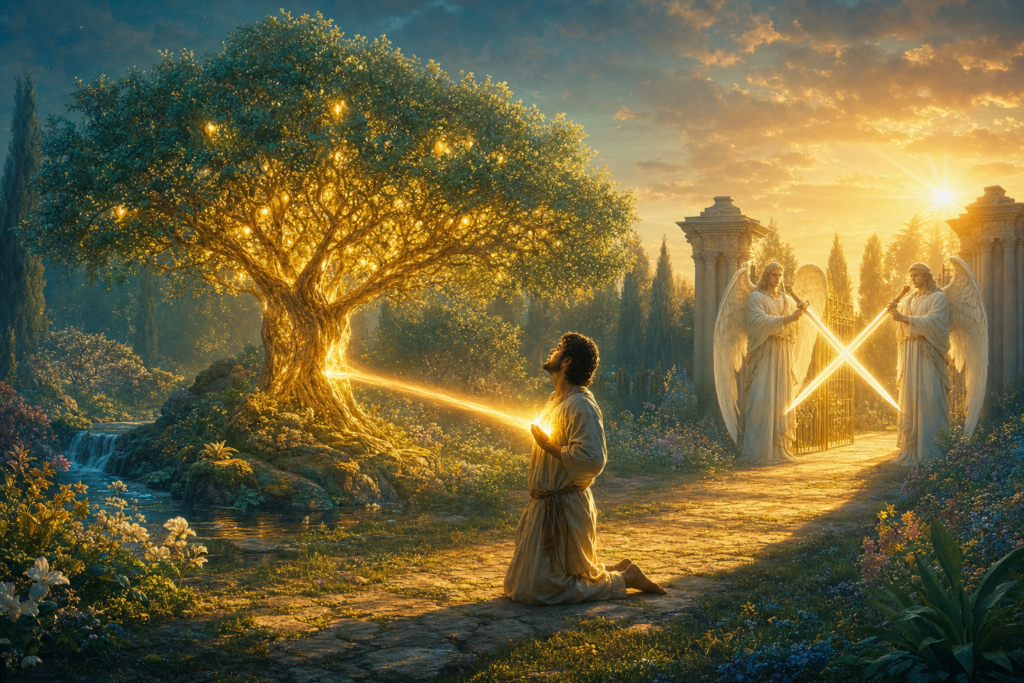
🔥 Cherubim and the Flaming Sword (Genesis 3:24)
The expulsion from the garden is read here as severe mercy. The tree of life is guarded so fallen humanity does not freeze rebellion into an eternal state, and the sword becomes a sign that access must now come by God’s own way.
- Being driven out is painful, yet it prevents eternalised corruption.
- The guarded eastward approach foreshadows later sanctuary patterns.
- The flaming sword means life is no longer taken casually.
- The study also links spiritual access on earth to human yielding and stewardship.
- Restriction itself is read as grace because eternal sin would be a darker captivity than temporary exclusion.
Genesis 3:24 (NKJV)
Genesis 3:24 — So He drove out the man; and He placed cherubim at the east of the garden of Eden, and a flaming sword which turned every way, to guard the way to the tree of life.
🌾 Cain’s Vegetable Offering vs Abel’s Blood
The study reads Cain and Abel as two approaches to God: self-chosen offering versus God-shaped sacrifice. Cain’s anger then shows what happens when man insists on his own covering rather than the way God has marked out.
| Brother | Offering | Outcome | Teaching emphasis |
|---|---|---|---|
| Cain | Fruit of the ground | Not respected | Self-selected approach, outward labour, anger when refused |
| Abel | Firstborn of the flock and their fat | Respected | Blood, firstlings, accepted way before God |
Genesis 4:3-5 (NKJV)
Genesis 4:3-5 — 3 And in the process of time it came to pass that Cain brought an offering of the fruit of the ground to the Lord. 4 Abel also brought of the firstborn of his flock and of their fat. And the Lord respected Abel and his offering, 5 but He did not respect Cain and his offering. And Cain was very angry, and his countenance fell.
📖 The Word Is the Tree of Life (Proverbs 3)
This section turns from garden imagery to wisdom language. The tree of life is treated not as a vague idea but as the living Word received, retained, and recognised in Christ rather than reduced to bare religious lettering.
- Wisdom’s ways are pleasant because the Word gives life, not merely pressure.
- The tree of life is held, not merely observed from afar.
- Scriptures must testify of Christ, otherwise the letter is handled without life.
- The sword is living because the Word is personal before it is instructional.
- Precise Bible literacy matters: even stray oral shorthands should push the reader back into the text rather than into borrowed confidence.
Proverbs 3:17-18 (NKJV)
Proverbs 3:17-18 — 17 Her ways are ways of pleasantness, and all her paths are peace. 18 She is a tree of life to those who take hold of her, and happy are all who retain her.
John 5:39 (NKJV)
John 5:39 — You search the Scriptures, for in them you think you have eternal life; and these are they which testify of Me.
1 Chronicles 26:18 (NKJV)
1 Chronicles 26:18 — At Parbar on the west there were four at the highway and two at Parbar.
The gatekeepers at the causeway picture guarded access — the same theme as cherubim at Eden’s east. Grace later opens what law and sword once sealed.
🌅 John 1, Genesis 1, and Revelation 19 — Three Beginnings
The study then sets three openings side by side. One speaks of the eternal Word, one of created heavens and earth, and one of the returning Christ still identified by the same divine name.
| Reference | Beginning described | Main point |
|---|---|---|
| John 1:1-3 | The eternal Word with God | Creation comes through Him |
| Genesis 1:1 | The beginning of heavens and earth | This is the beginning of creation, not of God |
| Revelation 19:13 | The victorious returning Christ | The same One is still called the Word of God |
John 1:1-3 (NKJV)
John 1:1-3 — 1 In the beginning was the Word, and the Word was with God, and the Word was God. 2 He was in the beginning with God. 3 All things were made through Him, and without Him nothing was made that was made.
Genesis 1:1 (NKJV)
Genesis 1:1 — In the beginning God created the heavens and the earth.
Revelation 19:13 (NKJV)
Revelation 19:13 — He was clothed with a robe dipped in blood, and His name is called The Word of God.
⛺ Garden East, Temple East, Ark of the Covenant
Once the garden is seen eastward, later worship patterns begin to echo it. The covenant at Sinai, the ark, the cherubim, and priestly approach all repeat the theme of guarded access around God’s own centre.
- Exodus 19 introduces covenant language after Genesis, so Sinai marks the formal old-covenant order.
- The people are called to treasured belonging and priestly identity.
- The ark gathers the testimony, manna, and rod under cherubic guarding.
- When religion lives by command alone, the centre is handled without its fullness.
Exodus 19:5-6 (NKJV)
Exodus 19:5-6 — 5 Now therefore, if you will indeed obey My voice and keep My covenant, then you shall be a special treasure to Me above all people; for all the earth is Mine. 6 And you shall be to Me a kingdom of priests and a holy nation.
Exodus 25:18-22 (NKJV)
Exodus 25:18-22 — 18 And you shall make two cherubim of gold; of hammered work you shall make them at the two ends of the mercy seat. 19 Make one cherub at one end, and the other cherub at the other end; you shall make the cherubim at the two ends of it of one piece with the mercy seat. 20 And the cherubim shall stretch out their wings above, covering the mercy seat with their wings, and they shall face one another; the faces of the cherubim shall be toward the mercy seat. 21 You shall put the mercy seat on top of the ark, and in the ark you shall put the Testimony that I will give you. 22 And there I will meet with you, and I will speak with you from above the mercy seat, from between the two cherubim which are on the ark of the Testimony.
Hebrews 9:4 (NKJV)
Hebrews 9:4 — which had the golden censer and the ark of the covenant overlaid on all sides with gold, in which were the golden pot that had the manna, Aaron’s rod that budded, and the tablets of the covenant;
🪨 From Garden Lock to Tomb Open — Word in the Heart
The guarded garden does not end the story. The resurrection scene is read as the reversal of confinement: the stone is moved for seekers, the angels stand where the body had lain, and the Word is no longer locked away.
- The stone is removed so witnesses may enter and see.
- Two angels at head and feet mirror guarded holy space.
- The risen Christ opens Scripture and locates Himself within it.
- The end of the movement is inward: the Word enters the heart.
John 20:1 (NKJV)
John 20:1 — Now the first day of the week Mary Magdalene went to the tomb early, while it was still dark, and saw that the stone had been taken away from the tomb.
John 20:12 (NKJV)
John 20:12 — And she saw two angels in white sitting, one at the head and the other at the feet, where the body of Jesus had lain.
Luke 24:27 (NKJV)
Luke 24:27 — And beginning at Moses and all the Prophets, He expounded to them in all the Scriptures the things concerning Himself.
⚖️ Law Empowers Sin (Romans 7; don’t preach thou shalt not)
This section argues that bare prohibition can intensify the very appetite it condemns. The warning is not against holiness, but against preaching law in a way that energises lust instead of unveiling Christ.
- Law can diagnose sin without curing it.
- Repeated “do not” language may awaken rebellious desire.
- The study keeps only the principle that restriction alone can inflame craving.
- Grace deals more deeply by changing desire at its root.
- When the church is left only with “thou shalt not”, authority and provision are easily obscured.
Romans 7:7-8 (NKJV)
Romans 7:7-8 — 7 What shall we say then? Is the law sin? Certainly not! On the contrary, I would not have known sin except through the law. For I would not have known covetousness unless the law had said, “You shall not covet.” 8 But sin, taking opportunity by the commandment, produced in me all manner of evil desire. For apart from the law sin was dead.
🏔️ Moses, the Veil, and the Transfiguration
No man can see God and live — yet grace creates a location where the forbidden becomes possible. Moses saw God’s back, not His face; Elijah and Moses appear with Christ on the mountain; and there the face of Jesus shines because grace has opened a door law alone could not hold.
- Moses removed his shoes because the ground was holy — a picture of grace granting standing.
- Adam was created and breathed into without ever seeing God’s face plainly.
- On the mount of transfiguration, Moses and Elijah stand in the promised conversation with Christ glorified.
- Grace qualifies the unqualified: God does not call the qualified; He qualifies the called.
Exodus 33:20 (NKJV)
Exodus 33:20 — But He said, “You cannot see My face; for no man shall see Me, and live.”
Matthew 17:1-2 (NKJV)
Matthew 17:1-2 — 1 Now after six days Jesus took Peter, James, and John his brother, led them up on a high mountain by themselves; 2 and He was transfigured before them. His face shone like the sun, and His clothes became as white as the light.
🎁 Grace Qualifies the Unqualified (tuxedo/hotel analogy)
Grace does not wait for perfect clothing, perfect résumé, or flawless performance. It provides what is missing and then grants entry, which is why self-righteous effort is exposed as too small for God’s kingdom.
- The tuxedo picture says the house provides the fit required for entry.
- Romans 8 locates the decisive work in God’s sending of His Son.
- Ecclesiastes warns against destructive self-made righteousness.
- The Moses motif underscores that grace grants access where law could not.
Romans 8:3 (NKJV)
Romans 8:3 — For what the law could not do in that it was weak through the flesh, God did by sending His own Son in the likeness of sinful flesh, on account of sin: He condemned sin in the flesh,
Ecclesiastes 7:15-16 (NKJV)
Ecclesiastes 7:15-16 — 15 I have seen everything in my days of vanity: There is a just man who perishes in his righteousness, and there is a wicked man who prolongs life in his wickedness. 16 Do not be overly righteous, nor be overly wise: Why should you destroy yourself?
❤️ Jesus Changes the Heart, Not the Hands (Matthew 5)
The closing movement brings the matter inward. Christ’s concern is not merely behaviour management but the hidden spring of desire, because the heart is where sin is conceived and where grace must be received.
- External restraint cannot heal internal lust.
- The eye and hand are examples, not the deepest problem.
- Jesus addresses concealed sin as seriously as visible failure.
- When the heart yields to Christ, conduct follows in changed order.
- Receive Jesus in the heart: when the heart is fixed, every other problem begins to move into right order.
Matthew 5:27-30 (NKJV)
Matthew 5:27-30 — 27 “You have heard that it was said to those of old, ‘You shall not commit adultery.’ 28 But I say to you that whoever looks at a woman to lust for her has already committed adultery with her in his heart. 29 If your right eye causes you to sin, pluck it out and cast it from you; for it is more profitable for you that one of your members perish, than for your whole body to be cast into hell. 30 And if your right hand causes you to sin, cut it off and cast it from you; for it is more profitable for you that one of your members perish, than for your whole body to be cast into hell.”
🎯 The Takeaway
- Grace gives direction to power; it does not leave spiritual life aimless.
- The tree in the midst is a life-giving centre, preparing the study to read Christ and His Word as God’s true provision.
- Blood, not leaves, addresses sin; therefore incarnation and atonement stand at the heart of access to God.
- The guarded garden, the ark, and the empty tomb form one movement from restriction to revealed access.
- The law can expose and even stir desire, but gift language points to what God Himself provides in Christ.
- Jesus targets the heart because transformed conduct grows from inward change, not from fear alone.
Scripture-based study on grace, the tree of life, the blood of atonement, covenant access, and the Word released within the heart.